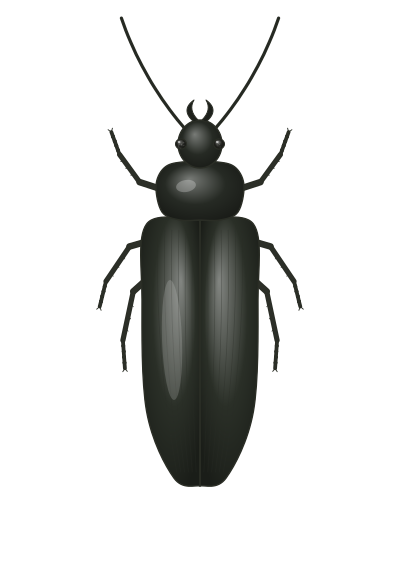
Simple and Incomplete Metamorphosis in Insects
Egg, nymph, adult: how cockroaches, bed bugs, grasshoppers, dragonflies and other insects grow up without a pupal stage, and why that matters when they move indoors.
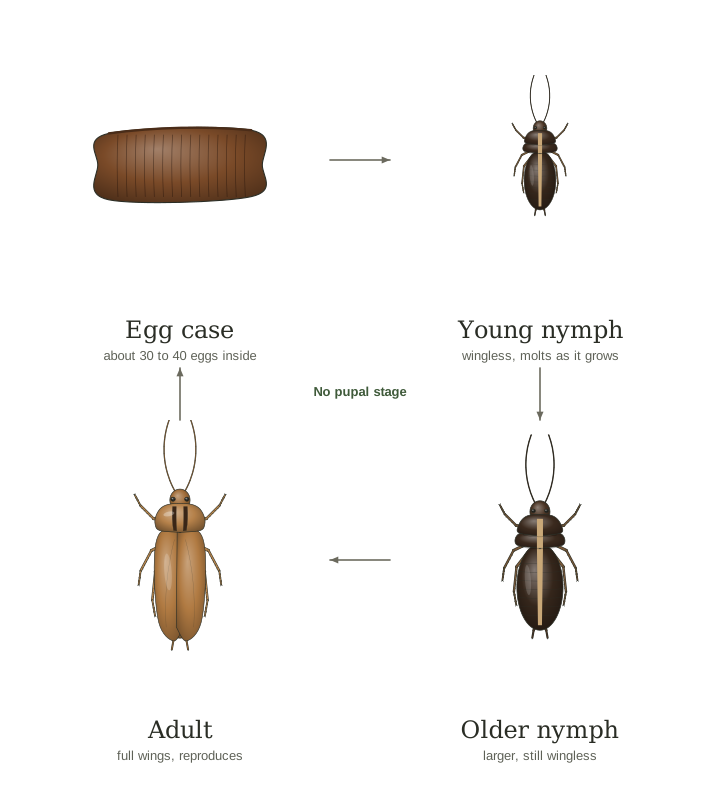
Simple metamorphosis, also called incomplete or gradual metamorphosis, is a life cycle with three stages: egg, nymph and adult. A nymph looks like a small adult without working wings. It grows by molting several times, and its wings develop step by step on the outside of the body until the final molt produces a winged adult that can breed. There is no pupal stage.
Cockroaches, termites, bed bugs, stink bugs, aphids, grasshoppers, crickets, earwigs, mantids, dragonflies and mayflies all develop this way. Beetles, flies, moths, ants, bees, wasps and fleas follow the other main pattern, complete metamorphosis, with a larva and a pupa.
Egg, nymph, adult: the three stages
Egg. Eggs may be laid singly, in clusters, glued to surfaces, pushed into soil or plant tissue, or packed in a protective case. Cockroaches and mantids enclose their eggs in a case called an ootheca. Grasshoppers lay theirs in pods in the soil.
Nymph. The young insect that hatches is a nymph. It has the same body plan as the adult: compound eyes, the same type of antennae and mouthparts, and three pairs of jointed legs. In most species it lives in the same place and eats the same food as the adult. It is smaller, cannot reproduce and has no working wings. Its proportions and color may differ, which is why nymphs are often mistaken for a different insect. Cockroach nymphs are a common example, covered on our cockroach nymph identification page.
Adult. The final molt produces the adult, or imago. In winged species it now has full-sized wings and mature reproductive organs. In nearly all insects, molting stops at this point.
Molting, instars and wing pads
An insect’s outer skeleton (the cuticle, described in external anatomy of insects) hardens after each molt and cannot stretch much. To grow, a nymph must build a new, larger cuticle under the old one and then shed the old one.
Hormones control the timing. A brain hormone triggers glands in the thorax to release molting hormone (ecdysteroids). The skin cells separate from the old cuticle and build a new one beneath it. The insect then splits the old skin and pulls itself out. The new cuticle is soft and pale for a short time before it hardens and darkens.
Each growth stage between two molts is an instar. A first-instar nymph has just hatched; a fifth-instar nymph has molted four times. Some species always have the same number of instars, while in others the count changes with temperature and food. Common examples:
| Insect | Nymphal instars (typical) |
|---|---|
| Bed bug | 5 |
| Most grasshoppers | 5 |
| Periodical cicada | 5 (over 13 or 17 years underground) |
| Brown marmorated stink bug | 5 |
| German cockroach | Usually 6 |
| Silverfish (ametabolous) | 45 to 60 instars over a lifetime |
Wing pads are the clearest sign of a nymph. In winged species, small flaps appear on the back of the thorax after the first or second molt and grow larger at each molt. They stay stiff and unusable until the final molt, when the full wings expand. Spotting wing pads tells you the insect is still developing.
Hormones also decide when the cycle ends. Juvenile hormone keeps the insect in its immature form at each molt. Its level falls in the last nymphal instar, which lets the final molt produce an adult.
Simple, incomplete, gradual: how the terms are used
The vocabulary for insect development is not fully standardized, and textbooks, extension sheets and older references use these words in slightly different ways. Here is how the terms are most often used, and where they overlap.
Simple metamorphosis and incomplete metamorphosis are broad, everyday terms for any life cycle with egg, nymph and adult but no pupa. They are generally used interchangeably.
Hemimetabolous (from Greek, “half change”) is the technical term. In many university courses it is simply the formal name for incomplete metamorphosis and covers every order with nymphs, land-dwelling or aquatic. North Carolina State University’s teaching materials use it this way, describing nymphs (or naiads, if aquatic) whose wing buds grow with each molt.
Paurometabolous (“little change”) and gradual metamorphosis are used by some authors for the land-dwelling version, where nymphs and adults share the same habitat and food. Cockroaches, grasshoppers and true bugs are common examples.
In that narrower scheme, hemimetabolous is kept for insects whose nymphs live in water and look quite different from the flying adults: dragonflies, damselflies, mayflies and stoneflies. Their aquatic young are called naiads. Texas A&M AgriLife Extension materials follow this split, listing paurometabolous (cockroach), hemimetabolous (dragonfly) and ametabolous (silverfish) as three forms of incomplete development.
Ametabolous (“no change”) describes insects with almost no metamorphosis. The young differ from adults only in size and sexual maturity, and there are no wings at any stage. Silverfish, firebrats and jumping bristletails develop this way. Unlike other insects, they keep molting after they become adults. Some authors list ametabolous development as a third type alongside simple and complete; others treat it as a form of incomplete development.
So if one textbook calls a cockroach hemimetabolous and another calls it paurometabolous, both are correct within their own definitions. The underlying biology is the same: no pupa, and young that resemble the adult.
| Term | Meaning | Typical examples |
|---|---|---|
| Ametabolous | No metamorphosis; wingless at all stages; adults keep molting | Silverfish, firebrats, bristletails |
| Paurometabolous (gradual) | Egg, nymph, adult; nymphs share habitat and food with adults | Cockroaches, termites, true bugs, grasshoppers |
| Hemimetabolous (narrow sense) | Egg, aquatic naiad, winged land adult | Dragonflies, damselflies, mayflies, stoneflies |
| Hemimetabolous (broad sense) | All incomplete metamorphosis; covers both rows above | All of the above except silverfish |
| Holometabolous (complete) | Egg, larva, pupa, adult | Beetles, flies, moths, ants, bees, wasps, fleas |
Aquatic naiads: dragonflies and mayflies
In a few orders the nymphs live in water while the adults fly, so the two stages look and behave very differently even though there is no pupa.
Dragonflies and damselflies. The naiads are fierce predators on the bottoms of ponds and streams. Each has a hinged lower lip (the labium) folded under its head. It shoots forward like an arm to grab prey. Damselfly naiads breathe through three leaf-like gills at the tip of the abdomen. Dragonfly naiads have gills inside the rectum and pump water in and out; a hard squeeze sends out a jet of water that pushes the naiad forward. When grown, the last-stage naiad leaves the water, and the winged adult emerges from its skin in the open air so its wings can dry.
Mayflies. Mayfly naiads live in streams and lakes and breathe through gills along the sides of the abdomen. They have one unusual step. The naiad molts into a winged subimago, which has cloudy wings and a dull, hairy body and can fly. The subimago then molts again into the true adult. Mayflies are the only living insects known to molt after they have working wings. Adult mayflies have no working mouthparts and do not feed. They live only briefly, in some species a single day, long enough to mate and lay eggs.
Stoneflies also have aquatic naiads. They live under rocks in cold, clean, fast streams. Because stonefly and mayfly naiads are sensitive to pollution, their presence is used as a sign of good water quality.
Worked examples
Cockroaches
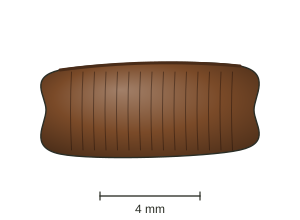
Cockroaches show simple metamorphosis plainly. The female forms an egg case, the ootheca, around her eggs. How she handles it depends on the species:
- German cockroach: the female carries the light brown case, about 8 mm long, sticking out from the tip of her abdomen until just before the eggs hatch, often for most of the roughly 30-day incubation. Each case holds about 30 to 40 eggs.
- American cockroach: the female carries the case for a few days, then glues it in a protected spot. Each holds about 12 to 15 eggs, which take about two months to hatch.
- Brownbanded cockroach: the female glues her cases to ceilings, furniture undersides and the inside of closets and cabinets.
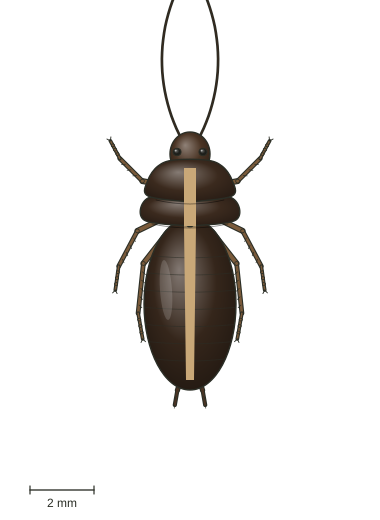
German cockroach nymphs are dark brown to nearly black, wingless, with two dark bands on the shield behind the head like the adults. They usually molt six times and take about 60 days at room temperature to reach adulthood. The full cycle from egg to egg-laying adult takes about 100 days, and because breeding is continuous, generations overlap. A growing population is roughly 80 percent nymphs and 20 percent adults. American and oriental cockroaches develop much more slowly, with nymphs taking 6 to 20 months to mature. For species and signs, see our cockroach guide.
Termites
Termites develop by simple metamorphosis too, and the caste system is built on it. The king and queen produce eggs, and the young that hatch are nymphs of both sexes. Most of them remain workers for life: soft, pale, wingless insects that build tunnels, gather food and care for the young. Some workers molt into soldiers, with large heads and jaws for defense. Others develop wing pads over successive molts and become winged reproductives, the swarmers (alates) that leave the colony each year to mate and start new colonies.
What a nymph becomes is controlled largely by chemical signals in the colony. Pheromones from the king and queen hold back other termites from becoming reproductives. If a founder dies, some workers can molt into replacement reproductives. Swarmers emerging indoors or right next to the foundation suggest the building itself may be infested; see termites for identification and signs.
Bed bugs
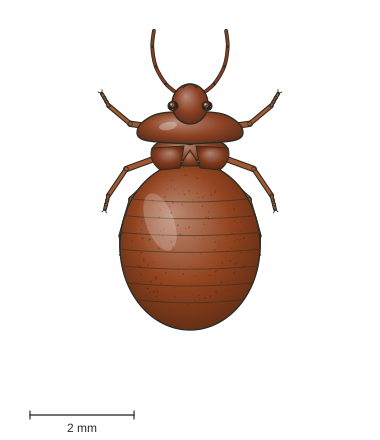
Bed bugs show how closely nymphs and adults share their way of life. Females lay one to several eggs a day, potentially hundreds over a lifetime, in cracks and seams near where people sleep. The eggs are tiny, whitish and sticky, and hatch in about a week at room temperature (CDC gives a range of about 4 to 12 days).
The newly hatched nymph is straw-colored and about the size of a pinhead. It passes through five nymphal stages, and each one must take a full blood meal before it can molt to the next. Adults also feed regularly, and females need blood to produce eggs. At 70 to 80°F (21 to 27°C) with regular access to a host, a bed bug can go from egg to adult in about a month, allowing several generations a year. Cooler conditions or scarce meals slow development. Nymphs and adults can go months without feeding. Each molt leaves behind a pale, empty skin, one of the main signs of an infestation. Our bed bug guide covers identification and signs.
True bugs generally
Bed bugs belong to Hemiptera, and simple metamorphosis is the rule across that order. Stink bug, squash bug, assassin bug and leafhopper nymphs all look like rounder, wingless versions of their adults and usually feed on the same plants or prey. The brown marmorated stink bug, for one, passes through five nymphal instars that grow from about 2.4 mm to 12 mm long, with colors that change from yellowish-red to off-white with red spots before the adult’s mottled brown. Periodical cicadas take this pattern to an extreme. Their nymphs live underground for 13 or 17 years, feeding on fluid from tree roots through five instars, then climb out, molt into adults and live only a few weeks. More on the order is on the Hemiptera page.
Grasshoppers
Most pest grasshoppers in the western and central United States complete one generation a year. Females lay eggs in the soil in summer and fall, in clusters of about 8 to 30 wrapped in a frothy coating that hardens into a protective pod. The eggs survive the winter and hatch in spring as soil warms. The nymphs feed on the same plants as the adults right away. They pass through five instars over about five to six weeks, developing small wing pads that grow at each molt. Only the adults can fly, so they are the stage that moves out of hatching areas.
Simple vs complete metamorphosis
| Feature | Simple (incomplete) metamorphosis | Complete metamorphosis |
|---|---|---|
| Stages | Egg, nymph (or naiad), adult | Egg, larva, pupa, adult |
| Do young resemble the adult? | Yes, apart from size, proportions and wings | No: caterpillars, grubs and maggots look nothing like the adult |
| Wing development | Visible wing pads on the outside that grow at each molt | Wings form inside the body and appear only after the pupa |
| Resting stage | None; nymphs are active the whole time | Pupa, which does not feed |
| Habitat and food of young | Usually the same as the adult (aquatic naiads are the exception) | Often different from the adult |
| Examples | Cockroaches, termites, bed bugs, stink bugs, aphids, grasshoppers, dragonflies, mayflies | Beetles, flies, mosquitoes, moths, butterflies, ants, bees, wasps, fleas |
In complete metamorphosis the larva is built for feeding and growth and the adult for dispersal and reproduction. The orders that develop this way hold more than four-fifths of known insect species. For the details of larvae and pupae, see complete metamorphosis. For how each order develops, see the orders of insects.
Why the life cycle matters for pest control
Life cycle shapes how an indoor infestation behaves and why control usually takes more than one step. The general principles are the same across most pests with simple metamorphosis.
Nymphs and adults live together. Because nymphs share the adults’ hiding places and food, an infestation includes every age at once. Seeing small nymphs means insects are breeding on site, not just wandering in. In a growing German cockroach population most of the insects are nymphs. Control has to reach the cracks where small nymphs hide, not just the spots where adults are seen.
Eggs are often protected. A cockroach ootheca shields the developing eggs inside it, and German cockroach females carry their egg cases while hiding and feeding less. Bed bug eggs are tucked into seams and crevices and are hard to remove by vacuuming. Many treatments that kill active insects do not reach or kill every egg, so new nymphs can hatch after a treatment that looked successful.
Timing follow-up to hatching. Egg incubation sets the minimum timing for a second look. German cockroach eggs hatch in about a month, and bed bug eggs in about a week or two. New nymphs emerging after the first treatment are expected, not necessarily a sign of failure. Follow-up inspections, repeat or continued treatment, and monitoring with sticky traps or bed bug interceptors confirm whether the population is truly gone. University extension guidance notes that bed bug control with insecticides usually needs more than one visit, and that cockroach baits work slowly and should be paired with ongoing monitoring.
Nymphs need what adults need. Bed bug nymphs cannot molt without a blood meal, and cockroach nymphs forage for food and water at every stage. Removing food, water and clutter slows growth at every stage, which is why sanitation and exclusion are part of every sound plan.
Read and follow the label on any product you use, and consider a licensed professional for bed bugs and for cockroach infestations that persist. For practical next steps, see cockroach control and bed bug treatment.
References
- Morphogenesis (Bug Bytes, ENT 425). North Carolina State University.
- Hormonal Control of Molting and Metamorphosis (Bug Bytes, ENT 425). North Carolina State University.
- Insect Life Cycles. Texas A&M AgriLife Extension, Travis County.
- German Cockroach, Blattella germanica (IN128). University of Florida IFAS Extension.
- Cockroaches (Pest Notes). University of California IPM.
- Bed Bugs (ENTFACT-636). University of Kentucky Entomology.
- Bed Bugs (DPDx). Centers for Disease Control and Prevention.
- Termites (Bug Bytes, social insects). North Carolina State University.
- Grasshoppers: Their Biology, Identification and Management (G1627). University of Nebraska-Lincoln Extension.
- Cockroaches and Their Control (G7384). University of Missouri Extension.
- Brown Marmorated Stink Bug. Penn State Extension.
- Brood XIX Cicadas. University of Georgia Extension, Lincoln County.
- Grasshopper fact sheet (Utah). USDA Agricultural Research Service.
- Order Ephemeroptera. North Carolina State University.
See also
- Complete metamorphosis
- The orders of insects
- External anatomy of insects
- Cockroach nymphs
- Hemiptera: true bugs
This page was last updated on October 7, 2026. We research our guides from university extension services, government agencies, museums and peer-reviewed literature. Read the editorial policy or report an error.