Complete Metamorphosis: Egg, Larva, Pupa and Adult
Beetles, moths, flies, fleas, bees and wasps all grow up in four distinct stages. Knowing which stage you are looking at tells you what the insect eats, where it hides and what to do about it.
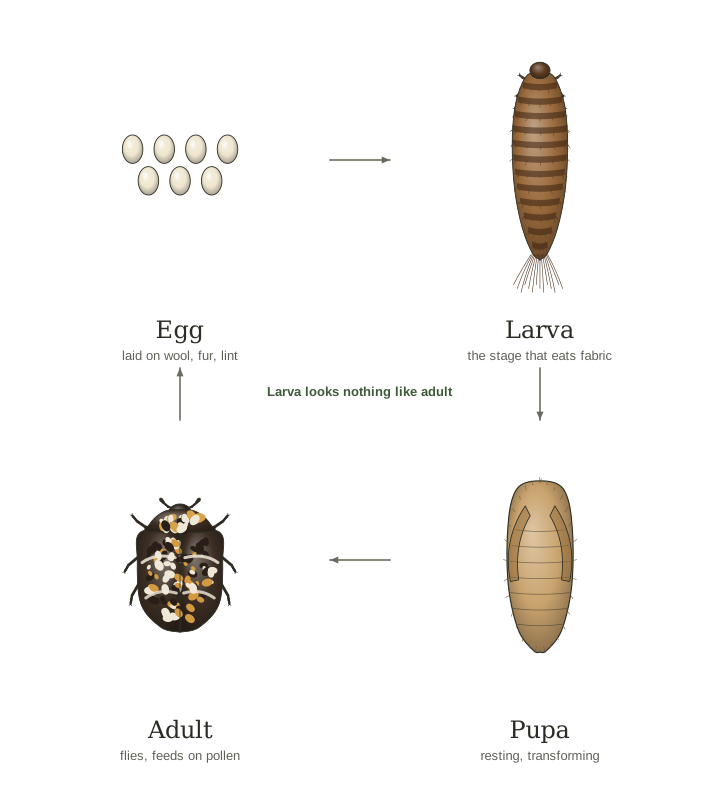
Complete metamorphosis is the four-stage life cycle of egg, larva, pupa and adult. The larva hatches looking nothing like its parents, eats and grows, then seals itself into a pupa where its body is reorganized into the adult form. Beetles, butterflies and moths, flies, fleas, bees, wasps, ants and several smaller orders develop this way.
Entomologists call these insects holometabolous (“wholly changing”). Their counterparts with simple or incomplete metamorphosis, such as cockroaches, grasshoppers and true bugs, hatch as nymphs that already resemble small adults. Our page on simple and incomplete metamorphosis covers that pattern.
The four stages
Egg
Females usually lay eggs on or in the food the larvae will need: a leaf, a seed, a wool sweater, a bag of flour, the soil under a lawn. Egg size, shape and placement vary enormously, and eggs are often the hardest stage to find.
Larva
The larva is the feeding and growing stage. It eats, molts its skin as it grows (each stage between molts is an instar), and stores the reserves needed for the pupal and adult stages. Larvae often have chewing mouthparts even when the adult does not. A caterpillar chews leaves; the moth it becomes sips nectar through a coiled tube, or does not feed at all.
Common names for larvae reflect the order:
- Caterpillars: butterflies and moths
- Grubs: many beetles, and bee and wasp larvae
- Maggots: many flies
- Wireworms, borers and other specialist forms: many beetles
Pupa
When the larva is fully grown, it stops feeding, often wanders to a sheltered spot, and molts into a pupa. The pupa does not feed and usually moves little or not at all, but it is far from resting. Inside, much of the larval body is broken down and rebuilt into adult structures: wings, adult legs and mouthparts, reproductive organs and flight muscles.
The wings of holometabolous insects develop inside the body during the larval stages rather than as visible pads on the outside. That is why entomologists also call this group the Endopterygota (“inner wings”).
Adult
The adult emerges from the pupal skin, expands and hardens its wings, and gets on with mating, dispersal and egg laying. Adults do not molt again or grow. A small fly is not a young fly; it is a fully grown small species.
Larval types
Entomologists group larvae by body plan. These terms appear in textbooks and identification keys, and they map loosely onto how the larva lives.
| Type | Body plan | Lifestyle | Examples |
|---|---|---|---|
| Eruciform | Cylindrical, with three pairs of true legs on the thorax and fleshy prolegs on the abdomen; short antennae | Slow-moving plant feeders | Caterpillars; sawfly larvae |
| Scarabaeiform | Soft, curved into a C shape; head points down; thoracic legs present | Live in soil or plant tissue; helpless when exposed | White grubs of June beetles and Japanese beetles |
| Campodeiform | Long, flattened, active; head points forward; well-developed running legs and strong jaws | Usually predators | Ground beetle, lady beetle and lacewing larvae |
| Elateriform | Long, hard, cylindrical, shiny; short legs; head points forward | Live in soil | Wireworms (click beetle larvae) |
| Vermiform | Legless, wormlike, often with a reduced head | Live inside food or a host | Fly maggots; flea larvae |
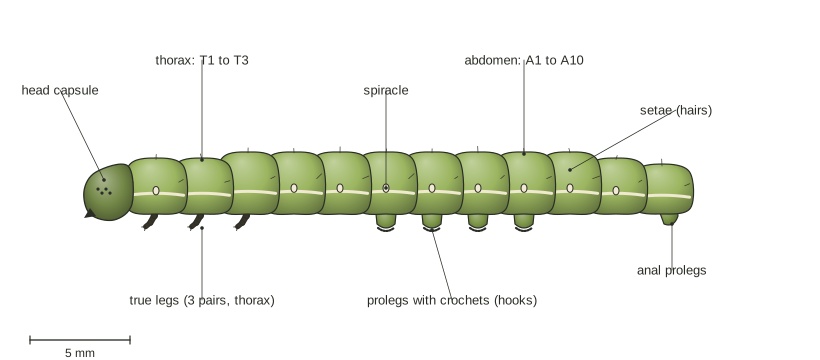
For help naming caterpillars, see our caterpillar identification guide.
The pupa: exarate, obtect and coarctate
Pupae are also grouped by how the developing legs, wings and antennae sit against the body.
- Exarate pupae have legs, wings and antennae free from the body, so the pupa looks like a pale, soft model of the adult. Beetles and bees, wasps and ants have exarate pupae.
- Obtect pupae have the appendages glued down against the body inside a hardened case. A butterfly chrysalis is an obtect pupa, and most moths have this type as well.
- Coarctate pupae form in more specialized flies, such as house flies. (Mosquitoes and some other flies have obtect pupae.) The pupa itself is exarate, but it develops inside the hardened skin of the last larval stage. That smooth, barrel-shaped case is called a puparium, and it can look more like a seed than an insect.
Cocoons, chrysalises and puparia
These three words are easy to mix up.
| Term | What it is | Who makes it |
|---|---|---|
| Cocoon | A silk case spun by the larva around itself before pupating | Many moths, fleas and some other insects |
| Chrysalis | The pupa itself, with its hard outer skin; no surrounding cocoon | Butterflies |
| Puparium | The hardened skin of the last larval stage, with the pupa inside | Many flies, including house flies |
A cocoon is something the larva builds. A chrysalis is the pupa’s own skin, and a puparium is the larva’s last skin. Some moths pupate in soil or leaf litter with no cocoon at all.
Which insect orders have complete metamorphosis
Holometabolous insects include these orders:
- Coleoptera (beetles); see our beetles page
- Lepidoptera (butterflies and moths)
- Diptera (true flies, including mosquitoes, house flies and fruit flies); see Diptera
- Hymenoptera (sawflies, wasps, bees and ants); see Hymenoptera
- Siphonaptera (fleas)
- Neuroptera (lacewings, antlions), plus the closely related alderflies, dobsonflies and snakeflies, which some texts include in Neuroptera
- Trichoptera (caddisflies)
- Mecoptera (scorpionflies)
- Strepsiptera (twisted-wing parasites)
Together these orders contain the majority of described insect species, and beetles alone account for roughly 40% of named insects.
Cockroaches, termites, grasshoppers, crickets, true bugs, lice, earwigs, dragonflies and mayflies do not have a pupal stage.
Why complete metamorphosis may have been so successful
Holometabolous insects are extraordinarily diverse. A 2024 study in the Proceedings of the National Academy of Sciences noted that more than half of all animal species are insects with complete metamorphosis. Why this life cycle has done so well is still an open question, and a few ideas get the most attention.
Larvae and adults use different resources. A caterpillar eats leaves; the butterfly drinks nectar. A grub eats roots; the beetle may eat foliage or pollen. When young and adults live in different places and eat different foods, they do not compete with each other. This is the explanation most often given in textbooks, though it is hard to test directly.
Growth and development can be separated. The 2024 PNAS study compared growth rates across many species and found that holometabolous larvae grow much faster than the nymphs of insects with simple metamorphosis. The authors argued that putting most of the rebuilding into a separate pupal stage frees the larva to concentrate on rapid growth, which pays off when food is short-lived or the risk of being eaten is high.
Each stage can specialize. The larva can become a near-perfect eating machine and the adult a near-perfect flying and mating one, without either having to compromise.
These ideas are not mutually exclusive, and none has been proven to be the single cause. Complete metamorphosis is also not required for success. Aphids, true bugs and termites all do very well without it.
Why it matters for household pests
For many pests in the home, the stage you see is not the stage doing the damage. In pests with complete metamorphosis, the larva usually causes most of the harm, while the adult is the one that flies to windows or lights where people notice it.
Carpet beetles. Adult carpet beetles feed on flower pollen and do not damage fabric; they often show up on windowsills in spring. Their bristly larvae feed on wool, fur, feathers, silk, felt, leather, lint and pet hair in closets, under furniture and along carpet edges. Killing the adults on the windowsill does nothing about larvae in a wool rug. See carpet beetles.
Clothes moths. Adult clothes moths do not feed at all. The creamy white larvae digest keratin in wool, fur, silk, feathers and leather, leaving holes, silk webbing or cases, and tiny droppings.
Pantry moths and beetles. Indianmeal moth larvae feed in grains, dried fruit, nuts, pet food and spices, and the silk webbing, droppings and shed skins they leave can spoil more food than they eat. Mature larvae often leave the food to pupate on shelves or containers some distance away, which is why people find caterpillars far from the infested package. Pantry beetles such as drugstore beetles, flour beetles and weevils follow the same pattern, with larvae living inside the food. See pantry pests.

Fleas. Adult fleas live on the pet and feed on blood. Their eggs fall off into carpet, bedding and pet resting areas, where small, legless larvae feed on adult flea droppings (dried blood) and other organic debris. The larvae spin silk cocoons that pick up dust and fibers for camouflage. Treating only the pet misses the eggs, larvae and pupae in the house. See fleas.
Three practical lessons follow.
- Look for the larvae. Find where the larvae feed and you have found the infestation.
- Expect a delay. Eggs and pupae hidden in carpets, cocoons or food packages can keep producing new adults for a while after the source is cleaned up.
- Identify the stage correctly. A small hairy “worm” under the bed and a tiny round beetle on the window can be the same carpet beetle species. Matching stages saves you from chasing two problems that are really one.
References
- Metamorphosis. University of California, Riverside (Legner).
- Rapid growth and the evolution of complete metamorphosis in insects (PNAS, 2024). Princeton University.
- Order Coleoptera. NC State University, General Entomology.
- Cat Flea, Ctenocephalides felis. University of Florida IFAS, Featured Creatures.
- Indianmeal Moth, Plodia interpunctella. University of Florida IFAS, Featured Creatures.
- Clothes Moths. University of Kentucky Entomology.
- Carpet Beetles. University of Kentucky Entomology.
See also
- Simple and incomplete metamorphosis
- Coleoptera: beetles
- Caterpillar identification
- Carpet beetles
- Pantry pests
- Fleas
This page was last updated on October 7, 2026. We research our guides from university extension services, government agencies, museums and peer-reviewed literature. Read the editorial policy or report an error.