House Ants: How to Identify Common Indoor Ants
A dozen or so species cause most ant problems in US homes, and a few simple features under a hand lens separate them.
Most ants that come into US homes are one of about a dozen species, and the most common are odorous house ants, pavement ants, carpenter ants, Argentine ants and, in the South, fire ants and crazy ants. You can usually narrow it down from size, color, where the ants are trailing, and a look at the waist under a hand lens: the number of bumps (nodes) between the thorax and abdomen splits house ants into two quick groups.
Getting the species right matters more with ants than with most pests. A trail of tiny ants on the kitchen counter, a few big black ants near a damp window, and a mound in the lawn call for different responses, and the wrong spray can make some infestations worse.
How to identify ants
Ants belong to the order Hymenoptera with bees and wasps (see Hymenoptera). Every ant has three body regions, elbowed antennae and a narrow waist. Workers, the ants you see foraging, are wingless females.
Use a hand lens or a phone camera zoomed in on a few ants, and check these features:
- Node count. The waist (petiole) has either one or two small bumps. Odorous house, carpenter, Argentine and crazy ants have one node. Pavement, pharaoh, thief, fire, little black and acrobat ants have two.
- Thorax profile. Seen from the side, carpenter ants have an evenly rounded, smooth upper thorax. Most other house ants have an uneven profile. Pavement and acrobat ants have a pair of small spines at the back of the thorax.
- Antenna club. In some small ants, the last few antenna segments are enlarged into a club. Pharaoh ants have a three-segment club; thief and fire ants have a two-segment club.
- Size. Note whether all workers are the same size (monomorphic) or whether sizes vary within a trail (polymorphic), as with carpenter and fire ants.
- Color. Black, brown, reddish, yellowish or two-toned.
- Odor. Crush one: odorous house ants smell like rotten coconut, and Argentine ants have a musty, greasy odor.
- Behavior. Steady trails, erratic running or stinging all help.
| Ant | Worker size | Color | Nodes | Quick clue |
|---|---|---|---|---|
| Odorous house | About 3 mm (1/8 in) | Brown to black | 1, hidden | Rotten-coconut odor when crushed |
| Pavement | 2.5 to 4 mm | Dark brown to black | 2 | Grooves on head and thorax; soil piles at slab cracks |
| Carpenter | 6 to 13 mm (1/4 to 1/2 in) | Black, or red and black | 1 | Rounded thorax; coarse sawdust |
| Argentine | About 3 mm (1/8 in) | Dull brown | 1 | Fast, busy trails; musty odor |
| Pharaoh | About 2 mm (1/12 in) | Yellow to light brown | 2 | Nests indoors; 3-segment club |
| Little black | About 1.5 mm (1/16 in) | Jet black | 2 | Tiny, shiny; small mounds outdoors |
| Acrobat | About 3 mm (1/8 in) or more | Often red and black | 2 | Heart-shaped abdomen; thorax spines |
| Red imported fire | 3 to 6 mm (1/8 to 1/4 in) | Reddish brown | 2 | Mounds in sun; painful stings |
| Thief | About 1.5 mm (1/16 in) or less | Yellowish | 2 | Very tiny; 2-segment club |
| Tawny crazy | About 2 to 2.4 mm | Reddish brown | 1 | Erratic running; huge numbers |
Common house ants
Odorous house ant
The odorous house ant (Tapinoma sessile) is one of the most common ants indoors across the US. Workers are about 3 mm (1/8 inch) long, brown to black and all the same size. The single node is flattened and hidden under the front of the abdomen, so the ant can look like it has no waist node at all. Crushed ants give off a smell like rotten coconut, which is the easiest field test.
Outdoors they nest shallowly under almost anything: stones, mulch, logs, pavers. Indoors they nest in warm, damp spots such as wall voids near hot water pipes and areas with leaks or condensation. Colonies have many queens and split easily, so a disturbed colony may move or break into several nests. They favor sweets and come indoors through foundation cracks, around door and window frames, along utility lines and over plants touching the house.
Pavement ant
The pavement ant (Tetramorium species) is a dark brown to black ant about 2.5 to 4 mm long. Under magnification you can see fine parallel grooves on the head and thorax and two small spines at the back of the thorax. It has two nodes.
Pavement ants nest in soil under sidewalks, driveways, slabs and large stones and come into buildings through cracks in foundations and floor slabs. Small piles of sand or soil next to those cracks are a giveaway. They eat almost anything that hits the floor, from sweets to grease to dead insects. Swarms of winged pavement ants come out in spring outdoors, but in heated buildings they can appear any time of year, including winter.
Carpenter ants
Carpenter ants (Camponotus species) are the largest common house ants. Workers vary in size within a colony, usually about 6 to 13 mm (1/4 to 1/2 inch), and queens can reach about 25 mm (1 inch). Most are black or red and black. They have one node and an evenly rounded thorax in side view, which separates them from other large ants.
Carpenter ants do not eat wood. They chew out nesting galleries, usually in wood that is moist or already softened by decay: around leaky windows and doors, under roofs, near tubs, sinks and dishwashers, and in attic beams. Signs of a nest indoors include:
- Coarse sawdust (frass) pushed out of small openings, often mixed with bits of insects and soil.
- Galleries that are smooth and clean, with a sanded look and no mud.
- Twenty or more workers seen indoors on a regular basis, especially in late winter and spring.
- Winged ants emerging indoors in late winter or spring.
- A faint rustling sound in walls from a large colony.
Carpenter ants vs termites. Both damage wood, but the evidence differs. Termite galleries are packed or lined with dried soil and run along the grain; carpenter ant galleries are clean. Carpenter ants push out sawdust; subterranean termites leave no loose debris, and drywood termites leave hard, six-sided pellets. See signs of termites for a side-by-side of each kind of debris, and termite vs flying ant to tell the swarmers apart.
A carpenter ant nest inside usually points to a moisture problem, so the leak needs fixing along with the ants.
Argentine ant
The Argentine ant (Linepithema humile) is a dull brown ant about 3 mm (1/8 inch) long with one node. Crushed workers have a musty, greasy smell. It is the most common household ant in California.
Argentine ants form enormous networks of linked nests with many queens, sometimes called supercolonies, and run in fast, busy, well-defined trails. They nest mostly outdoors in shallow soil, mulch and under objects, and invade homes for sweets and water, often suddenly when the weather turns hot and dry or very wet.
Pharaoh ant
The pharaoh ant (Monomorium pharaonis) is a tiny, yellowish to light brown ant about 2 mm (1/12 inch) long, with a slightly darker abdomen tip. It has two nodes and a three-segment antenna club. Unlike most house ants, it nests indoors in narrow spaces: voids around window and door frames, electrical outlets, between stored papers, under insulation, even under clothes in a drawer.
Pharaoh ants do not produce mating swarms. Colonies have many queens and spread by budding, where a group of workers and queens simply walks off to form a new nest. Repellent sprays seem to trigger this splitting, which is why spraying pharaoh ants tends to scatter them through a building. They are a serious problem in hospitals, where they can get into sterile supplies and wound dressings.
Little black ant
The little black ant (Monomorium minimum) is a tiny, shiny, jet-black ant about 1.5 mm (1/16 inch) long with two nodes. It looks like a black version of the pharaoh ant. It nests mostly outdoors in soil, where its small mounds are often mistaken for young fire ant mounds, and it forages indoors in trails.
Many people call any small black ant a “little black ant” or “sugar ant.” The odorous house ant and pavement ant are often the real culprits, so check the node count and the crush test.
Acrobat ant
Acrobat ants (Crematogaster species) are about 3 mm (1/8 inch) long or a little larger, often red and black. Seen from above, the abdomen is heart-shaped. They have two nodes and a pair of spines on the thorax.
Acrobat ants nest in dead or decaying wood and tree cavities outdoors, and in wall voids and moist wood indoors. Like carpenter ants, an indoor nest often marks a moisture problem. They feed heavily on honeydew from aphids and scale insects and follow strong trails.
Red imported fire ant
The red imported fire ant (Solenopsis invicta) is a reddish brown ant about 3 to 6 mm (1/8 to 1/4 inch) long, with workers of mixed sizes in the same colony. It has two nodes and a two-segment antenna club. It was introduced from South America in the 1930s and 1940s and is now established across the southern US.
Fire ants are mainly an outdoor pest. They build soil mounds, usually less than about 45 cm (18 inches) across, in lawns and planted areas, under patio slabs and along pavement edges. Workers grip with their jaws and sting repeatedly. Stings cause pain, redness and itching, and each one usually forms a white, pus-filled pustule. Fire ants sometimes forage indoors during extreme heat or flooding and can nest in electrical boxes and air conditioning units.
Thief ant
The thief ant (Solenopsis molesta) is one of the smallest house ants, about 1.5 mm (1/16 inch) or less, yellowish to light brown, with two nodes and a two-segment antenna club.
Thief ants nest mostly outdoors but forage indoors on counters, and they are usually more attracted to protein and grease than to sweets. They are easy to confuse with pharaoh ants; the antenna club (two segments for thief ants, three for pharaoh ants) separates them, but you may need a microscope.
Crazy ants
“Crazy ant” refers to several species in the genera Paratrechina and Nylanderia that run fast and erratically rather than in straight lines.
- The longhorn crazy ant (Paratrechina longicornis) is a slender brown ant about 3 mm (1/8 inch) long with very long legs and antennae. It runs erratically and can trail long distances.
- The tawny crazy ant (Nylanderia fulva), originally called the Rasberry crazy ant in Texas, is reddish brown, about 2 to 2.4 mm long, and covered in coarse hairs. It was found in large numbers in Florida in the 1990s and in the Houston area in 2002, and it has since spread to other Gulf Coast states and parts of the Southeast.
Tawny crazy ants nest outdoors under leaf litter, stones, potted plants and debris and form huge colonies with many queens. They spread over yards and into houses in enormous numbers, pile up inside electrical equipment and can cause short circuits. They do not sting. Because nests are outdoors and spread across neighborhoods, indoor treatment alone does not work, and control is most effective when whole areas are treated at once.
Why ants come inside
Ants enter houses for the same reasons they forage anywhere: food, water and shelter.
- Food. Crumbs, spills, pet food, sugary drinks, grease and garbage. Some species go for sweets, others for protein and grease.
- Water. Leaks, condensation, wet sponges, pet bowls and plant saucers.
- Weather. Hot, dry spells and heavy rain or flooding push outdoor colonies into buildings, which is why ants can appear suddenly.
- Nest sites. Wall voids, insulation, moist wood and gaps under slabs suit odorous house, carpenter, acrobat and pharaoh ants.
Ants usually enter through foundation cracks, gaps around doors and windows, utility lines, and tree branches or shrubs touching the house.
Flying ants and swarmers
Winged ants are the new queens and males of an established colony, leaving to mate and start new colonies. Most species swarm in warm weather, and colonies typically start producing swarmers only after a few years. Pavement ants nesting under heated buildings can swarm indoors from late fall into winter.
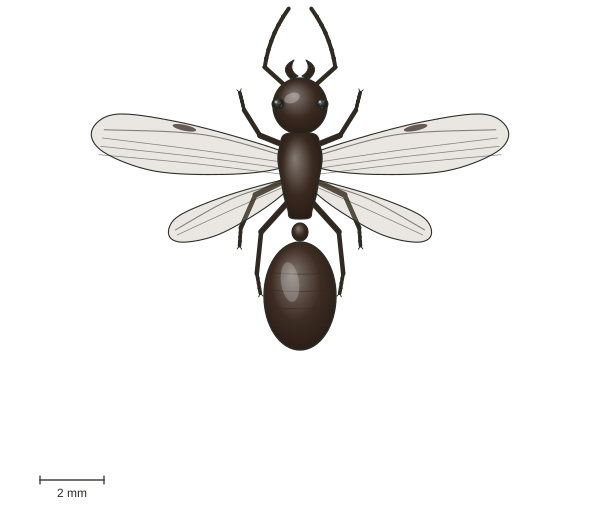
A few winged ants indoors may have flown in. Large numbers coming from inside walls or floors, especially in late winter or spring, point to a nest inside the house. Winged ants are often mistaken for termites; see termite vs flying ant for the differences.
Preventing ants
- Remove food. Wipe counters, sweep floors, rinse recyclables, store sweets and pet food in sealed containers, and empty trash often.
- Cut off water. Fix leaky faucets, pipes and sprinkler heads, and address condensation under sinks and in crawl spaces.
- Seal entry points. Caulk cracks and gaps around windows, doors, pipes and wires, and repair foundation cracks.
- Create a gap. Trim branches and shrubs away from the house and keep mulch and plants back from the foundation.
- Fix moisture-damaged wood. Replacing wet or rotten wood removes nest sites for carpenter and acrobat ants.
- Manage honeydew insects. Many ants tend aphids and scale insects on shrubs and garden plants, so controlling those cuts off a food source near the house.
Ant control
Ant control starts with the species, and then with the colony rather than the ants you can see. Killing foragers on the counter does not touch the queens or the nest.
- Baits are the main tool for most house ants. Workers carry slow-acting bait back to share with the colony, including the queens. Match the bait to what the ants are eating: sweet liquid baits for odorous house and Argentine ants, protein-based baits for thief and pharaoh ants. Results usually take days to weeks.
- Avoid repellent sprays on pharaoh and odorous house ants. Extension specialists report that repellent products can split these many-queen colonies into several new ones and make the problem harder to control.
- Carpenter ants call for finding the nest, fixing the moisture problem and removing damaged wood. Spraying foragers does little. Professionals often treat the nest directly.
- Fire ants are usually handled outdoors with baits, which workers carry to the queen; sprays often miss her.
- Tawny crazy ants usually need professional, area-wide treatment outdoors.
Read and follow the label on any ant product, and keep baits away from children and pets. Our ant control guide explains these methods step by step and when calling a professional makes sense.
References
- Pest Notes: Ants. University of California Statewide IPM Program.
- Ant Identification. Texas A&M AgriLife Extension.
- Ant Identification. University of Nebraska-Lincoln Extension.
- Carpenter Ants. University of Minnesota Extension.
- Odorous House Ant. Utah State University Extension.
- Pavement Ant. Penn State Extension.
- Pharaoh Ants. Cooperative Extension (Ant Pests).
- Fire Ants. Cooperative Extension (Pests in the Home).
- Tawny Crazy Ant, Nylanderia fulva (IN1076). University of Florida IFAS Extension.
See also
- Ant control
- Termite vs flying ant
- Signs of termites
- Bugs in the kitchen
- Tiny black bugs
- Hymenoptera: ants, bees and wasps
This page was last updated on October 7, 2026. We research our guides from university extension services, government agencies, museums and peer-reviewed literature. Read the editorial policy or report an error.