Bed Bugs: Identification, Life Cycle and Health Risks
Small, flat, blood-feeding insects that hide close to where people sleep and travel from place to place in luggage and furniture.
Bed bugs (Cimex lectularius) are small, flat, wingless insects that feed on human blood, usually at night. Adults are reddish brown and about 5 to 7 mm (3/16 to 1/4 inch) long, roughly the size and shape of an apple seed. They hide in mattress seams, bed frames and other cracks near where people sleep, and they reach new homes by hitching rides in luggage, bags and secondhand furniture.
They are not known to spread disease. The harm is itchy bites, lost sleep and a great deal of stress, plus an infestation that is hard to get rid of once it spreads. The good news is that early infestations are much easier to deal with, and a calm, step-by-step approach works better than throwing things away.
What bed bugs look like
Bed bugs are true bugs, members of the order Hemiptera (see Hemiptera: true bugs). Like other true bugs, they have a beak for piercing skin and sucking blood, which stays folded under the head when not in use.
Adults
- Size: About 5 to 7 mm (3/16 to 1/4 inch) long.
- Shape: Flat and broadly oval when unfed, thin enough to slip into a crack the width of a credit card. After feeding they swell, becoming longer, rounder and balloon-like.
- Color: Brown to reddish brown; redder after a blood meal.
- Other features: Short golden hairs, four-segment antennae and no working wings. They cannot fly or jump, but they crawl quickly.
Nymphs
Young bed bugs (nymphs) look like small adults. Newly hatched nymphs are about 1.5 mm long, roughly a pinhead, and translucent or pale straw-yellow. Unless they have fed recently, they can be nearly invisible to the naked eye; a fed nymph looks redder and easier to spot. The EPA lists the five nymph stages at roughly 1.5, 2, 2.5, 3 and 4.5 mm.
Eggs
Eggs are about 1 mm long and pearly white, about the size of a pinhead. Females glue them to rough surfaces such as wood and paper in cracks and seams near where people sleep. After about five days an eye spot can show through the shell. Empty eggshells often stay stuck in place after hatching, which helps with inspections.
Bed bug life cycle
Bed bugs develop through simple metamorphosis: egg, five nymphal stages, adult. There is no larva or pupa. Our page on simple and incomplete metamorphosis explains the pattern.
- Eggs hatch in about one to two weeks at room temperature.
- Each nymph needs a blood meal before it can molt to the next stage, so there are at least five meals between hatching and adulthood. Adult females also need blood to produce eggs.
- Development from egg to adult takes as little as about a month at 21 to 27 °C (70 to 80 °F) with steady access to a host, and up to several months in cooler conditions or when meals are scarce. Under good conditions there can be several generations a year.
- Females lay a few eggs a day and a few hundred over their lifetime.
- Adults live around 10 months to a year or more, depending on temperature and food.
How long bed bugs survive without feeding
This is one of the most misquoted bed bug facts, so the details matter. Bed bugs can survive for months between meals, but how long depends heavily on temperature, humidity and life stage.
- In heated homes at normal room temperatures, the University of Kentucky estimates typical survival without a meal at roughly 1 to 4 months.
- In cool conditions, around 13 °C (55 °F) or below, adults may survive a year or longer. UC IPM reports laboratory adults surviving more than 400 days at low temperatures.
- Older nymphs and adults survive longer than newly hatched nymphs.
So leaving a home empty for a few weeks will not starve out an infestation, and bugs may simply wait or move to other units.
Behavior: where and when they feed
Bed bugs are mostly active at night, feeding while people sleep. A feeding takes about 3 to 10 minutes, after which the bug returns to its hiding place.
They do not stay on people after feeding, and they do not build nests. They hide close to where people rest. The CDC notes that they can travel more than 100 feet in a night but usually stay within about 8 feet of a sleeping area. UC IPM reports that about 85 percent of infestations are in or near the bed, with the rest in upholstered furniture, nightstands, baseboards, under loose wallpaper and similar spots.
Bed bugs turn up in spotless homes and five-star hotels. An infestation is not a sign of poor housekeeping; it is a sign of contact with an infested place or item.
Bed bug bites and health risks
The CDC and EPA are clear on the most important point: bed bugs are not known to spread disease to people. They are a public health pest because of what the bites and infestations do to people’s skin, sleep and peace of mind.
What to know about bites:
- Bites are painless at the time. Bed bugs inject a small amount of anesthetic, so most people do not wake up.
- Reactions vary widely. Many people develop small, red, itchy welts, sometimes in a line or cluster. Others have no reaction at all; the University of Kentucky estimates around 30 percent of people may not react.
- Timing varies. Welts may appear within a day or be delayed by several days. The CDC notes that in some people they take up to 14 days to show.
- Location: Bites can appear on any skin exposed during sleep. Flea bites, by comparison, tend to cluster around the ankles and lower legs.
- Problems beyond itching: Scratching can lead to skin infections. Severe allergic reactions are rare. Loss of sleep, anxiety and stress are common in people dealing with an infestation.
Do not diagnose bed bugs from bites alone. Bites from fleas, mosquitoes, mites and other insects look similar, and so do many skin conditions. The only way to confirm bed bugs is to find the bugs, their eggs or skins, or their fecal spots. A doctor can help with itching, a skin infection or a strong reaction.
How bed bugs spread
Bed bugs do not fly or jump, so they move with people and their belongings.
- Travel: Hotels, motels, dorms, cruise ships, shelters and vacation rentals. Bugs climb into luggage, bags and folded clothing.
- Secondhand items: Used mattresses, box springs, bed frames, upholstered furniture and anything stored in an infested home.
- Multi-unit buildings: Bugs move between apartments through wall voids, along pipes and wiring, and in hallways.
- Visitors and carried items: Backpacks, purses and coats set on infested furniture.
Why early detection matters
A few bugs brought home in a suitcase can grow into an infestation over a few months, because females lay eggs steadily and development is fast at room temperature. In the early stages, bugs and their signs are concentrated on the bed and are much easier to find and treat. As numbers grow, bugs spread to nearby furniture, along baseboards and eventually into other rooms or neighboring apartments, and control becomes slower and costlier. The EPA advises checking for signs when you change bedding or come home from a trip, for exactly this reason.
Bed bug look-alikes
Several small insects are mistaken for bed bugs. A close look, a clear photo or an expert’s opinion prevents a lot of wasted effort.
- Bat bugs and swallow bugs. Close relatives that look almost identical and feed mainly on bats and birds. They bite people when their hosts leave a roost or nest in an attic, chimney or eave. Under magnification, bat bugs and swallow bugs have longer hairs on the shield behind the head (longer than the width of the eye) than bed bugs do. The distinction matters: control starts with dealing with the bats or birds, not with treating the bedroom.
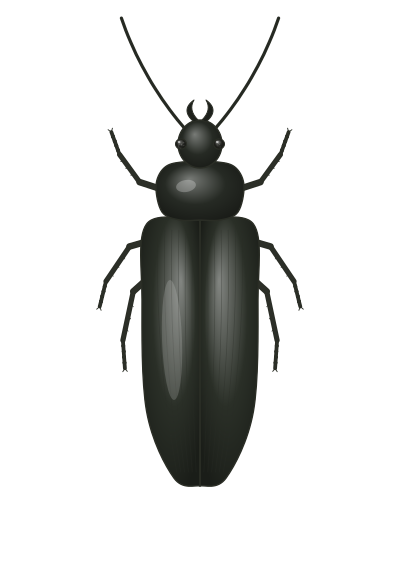
- Carpet beetles. Adults are small, oval beetles, black or mottled with white, brown and yellow, and larvae are tiny, slow and densely hairy. The EPA singles them out as easily mistaken for bed bugs. See carpet beetle vs bed bug.
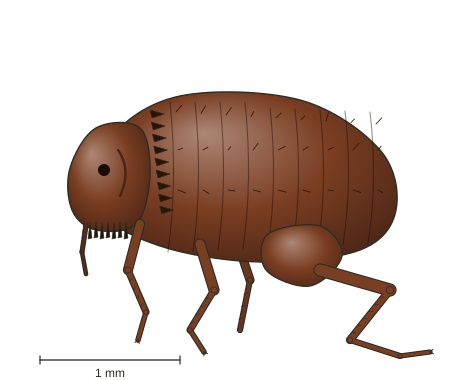
- Fleas. Small, reddish brown, wingless, and flattened side to side rather than top to bottom. They jump, and bites tend to be around the ankles. See flea vs bed bug.
- Cockroach nymphs. Young German cockroaches are about the size of a bed bug, but they are longer, faster and have long antennae. See cockroach nymphs.
- Conenose (kissing) bugs. Larger, up to about 19 mm (3/4 inch), and adults have wings.
Signs of bed bugs
The main signs of an infestation are dark fecal spots along mattress seams and in cracks, rusty blood smears on sheets, pale shed skins, tiny white eggs and eggshells, and live bugs. In heavy infestations there may be a sweet, musty odor.
Our signs of bed bugs guide walks through each sign and gives a room-by-room checklist of where to look.
Preventing bed bugs
When traveling
- Inspect the bed when you arrive, especially the mattress seams and headboard near the pillows, and look over the luggage rack. A flashlight helps.
- Keep luggage on a rack or a hard surface away from the bed and walls, and keep it zipped.
- When you get home, unpack straight into the washer, then put clothes through a hot dryer cycle. The EPA notes that washing alone will generally not kill bed bugs; high heat in the dryer does.
- Inspect your suitcase and store it in a garage or basement, not under the bed.
With secondhand furniture and clothing
- Inspect used beds, mattresses and upholstered furniture for fecal spots, skins and eggs before bringing them home. Look in seams, joints, screw holes and under fabric.
- Avoid picking up furniture left at the curb.
- Put used clothing and fabrics through a hot dryer before storing them.
At home
- Cut clutter, especially around beds, so bugs have fewer places to hide and are easier to spot.
- Consider tight-fitting, tested mattress and box spring encasements, which remove hiding places and make inspection easier.
- In apartments, report suspected bed bugs to building management early, since bugs can move between units.
- Check bedding and the bed frame when you change sheets, especially after travel or guests.
Bed bug control
Bed bugs are among the hardest household pests to eliminate, and most infestations need more than one method. Extension and EPA guidance points to integrated pest management:
- Confirm the identification before treating.
- Do not panic or start throwing things out. Most items can be treated and kept, and moving or discarding infested items carelessly spreads bugs.
- Non-chemical methods come first: hot dryer cycles for bedding and clothes, vacuuming seams and cracks, steam on some surfaces, encasements and interceptor traps under bed legs.
- Insecticides labeled for bed bugs can be part of a plan. Read and follow the label exactly. Do not use products on mattresses or bedding unless the label allows it.
- Avoid total-release foggers (“bug bombs”). They do not reach bugs hiding in cracks and are not a stand-alone solution.
- Professional treatment, including whole-room heat treatment, is often the most reliable route for established infestations.
Our bed bug treatment guide covers each method, how to prepare a room, and when to bring in a licensed professional.
References
- Bed Bugs: Appearance and Life Cycle. US Environmental Protection Agency.
- About Bed Bugs. Centers for Disease Control and Prevention.
- Bed Bugs (ENTFACT-636). University of Kentucky Entomology.
- Pest Notes: Bed Bugs. University of California Statewide IPM Program.
- How to Find Bed Bugs. US Environmental Protection Agency.
- Tips for Travel. US Environmental Protection Agency.
- Top Ten Tips to Prevent or Control Bed Bugs. US Environmental Protection Agency.
- Carpet Beetles (ENTFACT-601). University of Kentucky Entomology.
- Pest Notes: Fleas. University of California Statewide IPM Program.
See also
- Signs of bed bugs and where they hide
- Bed bug treatment
- Carpet beetle vs bed bug
- Flea vs bed bug
- Bugs in bed
- Hemiptera: true bugs
This page was last updated on October 7, 2026. We research our guides from university extension services, government agencies, museums and peer-reviewed literature. Read the editorial policy or report an error.