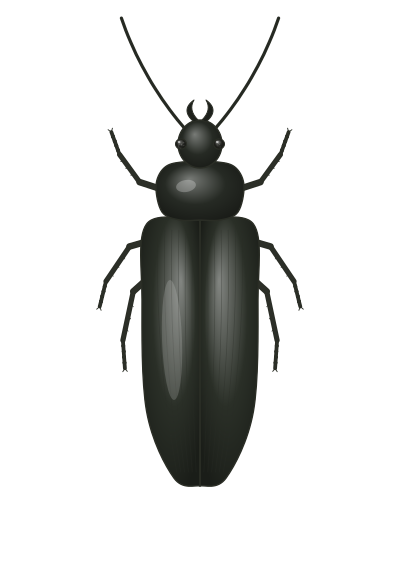
Powderpost Beetles: Damage, Exit Holes and Identification
Small wood-boring beetles whose larvae turn hardwood floors, furniture and framing into fine powder, leaving tiny round holes behind.
Quick answer
Powderpost beetles are small beetles whose larvae tunnel inside dry wood and leave tiny round exit holes with fine, flour-like powder sifting out. The three main groups are lyctids, anobiids and bostrichids. Hole size, the texture of the powder and the type of wood tell them apart. Fresh, light-colored powder and crisp holes mean an active infestation; yellowed, caked powder usually means old damage.
Powderpost beetles are small wood-boring beetles whose larvae tunnel through dry wood and reduce it to powder. The usual sign is a scatter of tiny round holes in wood flooring, trim, furniture or framing, with small piles of fine dust beneath them.
They rank second only to termites as pests of dry, seasoned wood, according to University of Kentucky Entomology. The good news is that the damage is slow. Most infestations take years to become serious, so there is time to confirm what you have before deciding what to do.
What powderpost beetles are
“Powderpost beetle” covers three groups of beetles (order Coleoptera) with similar habits:
- Lyctid powderpost beetles (subfamily Lyctinae), sometimes called true powderpost beetles
- Anobiid beetles (family Anobiidae), which include the furniture beetle and deathwatch beetles
- Bostrichid beetles (family Bostrichidae), often called false powderpost beetles
In all three, the adult is short-lived and rarely seen. Females lay eggs in pores, cracks or old exit holes in bare wood. The larvae hatch and spend months to years tunneling inside, packing their galleries with powdery waste called frass. When they finish developing, they pupate near the surface and the adult chews straight out, leaving a round exit hole. That is the first thing most people see.
Because the larvae work entirely below the surface, the wood can look sound while the inside is riddled with tunnels.
Types of powderpost beetles
Lyctid powderpost beetles
Lyctids attack only hardwoods, mainly the sapwood of large-pored woods such as oak, ash, walnut, hickory, cherry and mahogany. Bamboo and tropical hardwoods are especially prone. They rarely infest softwood framing.
Their larvae depend on the starch in fairly new wood. University of Kentucky notes that females avoid wood with starch below about 3 percent, which is why lyctids show up mostly in wood that was cut and processed fairly recently, often emerging within a year or so. New flooring, cabinets, paneling, molding and furniture are common sources, usually with the beetles already inside when installed.
- Adults: narrow, reddish brown to black, about 2 to 6 mm (1/16 to 1/4 inch)
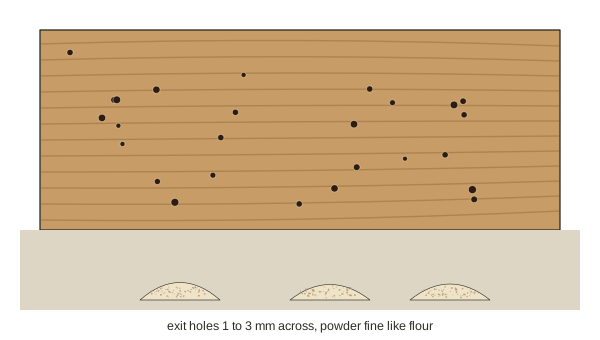
- Exit holes: round, about the size of a pinhead (roughly 0.8 to 1.6 mm)
- Frass: very fine, like flour or talcum powder, with no pellets; sifts out easily and piles beneath holes
- Life cycle: usually under a year in newly seasoned wood; two or more years in older wood, with stragglers emerging for up to about five years
- Moisture: can infest wood as dry as about 8 percent moisture content
- Reinfestation: will reinfest the same wood
Anobiid beetles
Anobiids attack both hardwoods and softwoods, including sapwood and heartwood. Unlike lyctids, they can digest cellulose, so they do not need starch and can attack wood of any age. University of California IPM notes that deathwatch beetles mainly attack softwoods such as Douglas-fir, often old or partly decayed wood.
Moisture is the deciding factor. Anobiid larvae need wood with roughly 13 percent moisture or more, so infestations are most serious in damp crawl spaces, basements, garages and unheated outbuildings. Centrally heated and air-conditioned living areas are usually too dry. They are more common in southeastern and coastal states, and infestations are seldom obvious in buildings less than about 10 years old.
- Adults: convex, reddish to dark brown
- Exit holes: round, about 1.6 to 3 mm (1/16 to 1/8 inch)
- Frass: gritty, containing tiny elongated or bun-shaped pellets you can feel between your fingers
- Life cycle: often about two years, and longer in poor conditions
- Reinfestation: will reinfest
Anobiids are the group most likely to damage structural wood such as joists, sills and beams.
Bostrichid beetles
Bostrichids (false powderpost beetles) bore mainly into hardwood sapwood, including tropical hardwoods and bamboo, and occasionally softwoods. Adults hold the head bent down under a hood-like thorax that is rough like a rasp, and some have a pair of spines at the rear.
- Adults: about 3 to 6 mm (1/8 to 1/4 inch), reddish brown to black
- Exit holes: round and larger than other powderpost beetles, about 3 to 7 mm (1/8 to 1/4 inch)
- Frass: coarse and gritty, packed tightly in the tunnels and tending to cake
- Life cycle: most species about one year
- Reinfestation: rarely reinfest after the first generation
Bostrichid damage can be extensive in the first year, but because they rarely come back, a single generation is often the end of the problem.
Identifying the damage
Hole size and frass texture are the most useful clues. Roll a pinch of powder between your fingers and look at it under a magnifier.
| Group | Exit hole | Frass | Wood attacked | Reinfests? |
|---|---|---|---|---|
| Lyctid | 0.8–1.6 mm, pinhead | Very fine, like flour or talc | Hardwoods, mostly newer wood | Yes |
| Anobiid | 1.6–3 mm | Gritty, with tiny pellets | Hardwoods and softwoods, any age, damp | Yes |
| Bostrichid | 3–7 mm | Coarse, tightly packed | Mostly hardwoods | Rarely |
Hole and frass ranges overlap at the edges, and exact identification sometimes needs an entomologist or experienced inspector. For a homeowner, the main questions are whether the infestation is active and whether the wood is structural.
Active vs old infestations
Many old houses and antiques carry holes from beetles that died out years ago. Before you treat or replace anything, find out whether beetles are still at work.
Signs of an active infestation:
- Powder that is fresh and light-colored, like newly sawed wood
- Small piles of powder that reappear after you clean them up
- Holes with crisp edges and clean, bright interiors, not weathered or dark
- Holes in stained or finished wood that show bare, unstained wood inside
- Small beetles on nearby windowsills, especially in spring and summer, since many species fly toward light
Signs of old damage:
- Powder that is yellowed, caked, or covered with dust and debris
- Holes that are dark and weathered inside, or stained along with the wood surface
To test, University of Kentucky suggests vacuuming away all powder, marking or sealing the existing holes, and checking again over several months, especially in spring and summer. New holes or fresh powder confirm activity. Bumping or vibration can shake loose old powder, so one small pile on its own is not proof.
Why moisture matters
Wood moisture content controls which beetles can survive and how fast they develop:
- Lyctids can develop in wood as dry as about 8 percent moisture, which is why they turn up in dry, heated homes. Very dry wood slows them down rather than stopping them.
- Anobiids need wetter wood, around 13 percent or more. University of Kentucky notes that anobiid development is generally unsuitable below about 14 percent moisture in spring and summer.
That makes moisture control one of the most effective tools against anobiids. Vacation homes and cabins are more prone to attack because intermittent heating and poor ventilation keep wood moisture higher, according to University of Missouri Extension.
Powderpost beetles vs termites and carpenter ants
Several insects damage wood, and the evidence they leave is different:
- Drywood termites push out hard, gritty fecal pellets that look like ground pepper, with ridges along their sides. Powderpost beetle frass is fine powder by comparison.
- Subterranean termites build mud tubes and line their galleries with mud. They do not leave piles of fine powder.
- Carpenter ants do not eat wood. They excavate nests and push out sawdust-like shavings that may contain dead ants and bits of the insects they eat. Their galleries are smooth and clean, with no mud or packed powder.
- Powderpost beetles leave neat round holes and powder-packed tunnels.
Our signs of termites page shows what termite evidence looks like. If you are unsure, a sample of the powder and a photo of the holes are what an extension office or inspector will want to see.
Prevention
Powderpost beetles lay eggs only in bare, unfinished wood. Paint, varnish, polyurethane, wax and other finishes seal the pores and generally prevent new attacks. Most prevention follows from that:
- Buy kiln-dried lumber from reputable sources. Kiln drying kills beetles already in the wood, though it does not prevent later reinfestation.
- Inspect wood before it comes indoors. Look for holes and powder in flooring, furniture, bamboo, imported wood products and especially salvaged barn wood or old lumber.
- Finish exposed wood. Seal bare surfaces on furniture, paneling and trim.
- Control moisture. Cover crawl space soil with plastic sheeting, improve drainage and ventilation, and keep heating and cooling consistent.
- Store firewood outside and bring in only what you will burn soon.
- Seal emergence holes in finished wood to keep females from using them as egg sites.
Control options
Wait and confirm
Because damage is slow, an immediate response is rarely needed. If you are unsure whether beetles are active, monitor for a season first. Fresh holes that stop appearing mean the problem may already be over.
Remove and replace
For small areas, the most reliable fix is to remove the infested pieces, plus adjoining boards as a precaution, and replace them with sound, finished wood. University of Kentucky suggests waiting at least six months before sanding and refinishing a floor in case more beetles emerge.
Heat and cold for small items
Small, movable wooden items can be treated with heat or cold. University of California IPM lists heating at 120 to 140°F (49 to 60°C) for 6 hours, or freezing at 0°F (-18°C) for 72 hours. Pieces thicker than about 2 inches (5 cm) may need longer. UC IPM limits this to items without fabric, pelts or paint, so plain wood pieces are better candidates than upholstered or painted antiques.
Wood treatments
Borate wood preservatives can be applied to bare, unfinished wood, where they soak in and kill larvae feeding in the treated wood. They do not penetrate paint, varnish or other finishes, and they penetrate poorly into very dry wood, so they are used mainly against anobiids in unfinished structural wood such as crawl space framing. In some states, such as California, these treatments are applied by licensed professionals. Insecticide sprays on wood surfaces mostly kill adults as they emerge rather than larvae deep inside. Any product must be labeled for wood-boring beetles; read and follow the label.
Professional treatment
For widespread infestations in walls or between floors, or for prized furniture, a licensed pest management professional can assess the damage and choose a method. Professionals may fumigate individual furniture pieces in a chamber or, in severe structural cases, fumigate a whole building. Structural fumigation is costly, requires occupants to leave for several days, and does not prevent reinfestation, so it is generally reserved for anobiid infestations that cannot be reached any other way. Our guide on when to call a professional covers how to choose and what to ask.
References
- Powderpost Beetles. University of Kentucky Entomology.
- Wood-Boring Beetles in Homes. University of California Statewide IPM Program.
- Wood-Boring Beetles (G7422). University of Missouri Extension.
- Biology and Management of Carpenter Ants (B1225). University of Georgia Cooperative Extension.
See also
- Signs of termites
- Termite treatment methods
- Beetles in the house
- When to call a professional
- Coleoptera: beetles
This page was last updated on October 7, 2026. We research our guides from university extension services, government agencies, museums and peer-reviewed literature. Read the editorial policy or report an error.