Signs of Termites: Mud Tubes, Droppings, Swarmers and Damage
A sign-by-sign guide to termite evidence in and around a house, with the look-alikes that cause false alarms.
Quick answer
The surest signs of termites are pencil-width mud tubes on foundations or wood, swarmers or piles of shed wings indoors, and wood with tunnels packed with dried soil. Small piles of hard, six-sided pellets point to drywood termites instead. Any of these is worth a professional inspection, but leave the evidence in place until then.
The clearest signs of termites are mud tubes running up a foundation or across wood, swarmers or loose wings indoors, and damaged wood with tunnels lined or packed with dried soil. Those three point to subterranean termites, the most common type in US homes. Drywood termites leave a different calling card: small piles of hard, six-sided pellets below infested wood.
Each sign below includes what it looks like, which termite group it suggests, and what can be mistaken for it. If you have not yet confirmed the insect itself, start with our termite identification guide.
Mud tubes
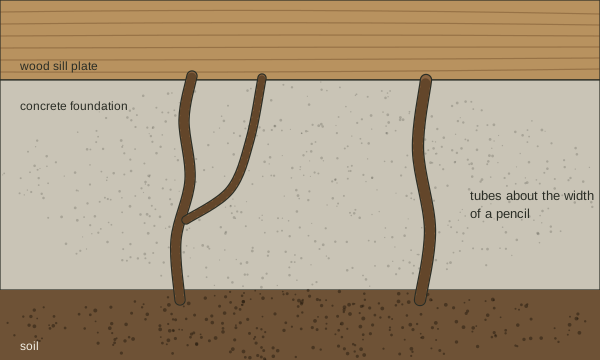
What they look like: Earth-colored tubes, usually about the width of a pencil, made of soil, chewed wood and saliva. They run up foundation walls, piers, pipes, sill plates, joists and door or window trim. They can be tucked along cracks, behind siding or baseboards, or in crawl spaces, so look closely at corners and seams.
What they point to: Subterranean termites, including the Formosan termite. Termites build the tubes to travel between the soil and wood without drying out or meeting predators. Tubes on a foundation, pier or plumbing are usually a sure sign of infestation.
A few patterns help:
- Working tubes connect soil to wood. Drop tubes hang from wood back toward the ground. Exploratory tubes rise from the soil and stop without reaching wood.
- Tubes high on interior walls, ceilings, soffits or fascia usually indicate Formosan termites, according to Mississippi State University Extension.
- Tubes running over or through foam insulation are also common with Formosan termites, though native species can do it too.
An empty tube does not prove the infestation is over. Termites may have moved to another route.
Swarmers indoors
What they look like: Dark brown to black (native subterranean) or yellowish brown (Formosan and drywood) winged insects, about 10 to 13 mm (3/8 to 1/2 inch) long with wings. They have straight antennae, a thick waist and two pairs of wings of equal length. Indoors, they cluster at windows, doors, vents and light fixtures because they are drawn to light.
What they point to: A mature colony in or under the house. Swarmers coming out of walls, floors or ceilings, or large numbers indoors, are a strong sign of infestation inside the structure.

Timing gives a further clue. Native subterranean termites usually swarm in daylight in late winter and spring, often after rain. Formosan termites swarm at dusk or after dark in late spring and pile up under lights. Some drywood species swarm at dusk or night, others by day in late summer and fall.
Swarmers found outdoors are less conclusive. Mississippi State notes that swarmers coming from a stump, log or woodpile 25 feet or more from the house are rarely a concern for the building, while swarmers near the foundation call for an inspection. In heavily infested Formosan areas, a few swarmers can fly in from outside toward lights, but hundreds indoors point to a problem in the building.
Killing swarmers does nothing to the colony. Indoor swarmers die on their own within a day or so because they cannot reach soil. Save a few as a sample before you vacuum the rest.
If you are not sure whether you are looking at termites or ants, see termite vs flying ant.
Discarded wings
What they look like: Small, translucent, pale gray to brownish wings of equal size, often in piles on windowsills, floors, porches or caught in spider webs.
What they point to: Termite swarmers that landed, paired off and broke off their wings. Extension specialists treat piles of shed wings indoors as a strong sign of a colony in or under the building. Ant swarmers shed wings too, but ant wings come in two sizes, with the front pair longer than the back pair.
Droppings and frass
Termite “droppings” are only visible with drywood and dampwood termites. Subterranean termites use their feces as building material in tubes and galleries, so you will not find loose piles from them.
Drywood termite pellets
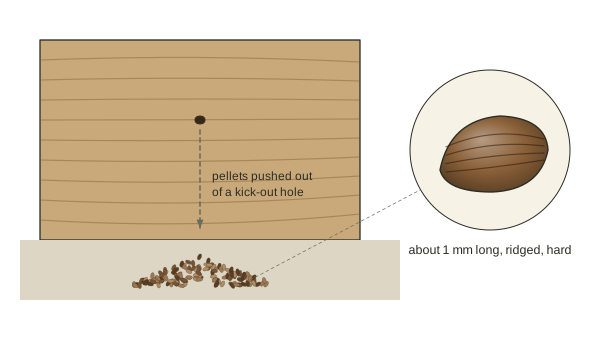
What they look like: Hard, gritty pellets about 1 mm long, often described as looking like coffee grounds or coarse ground pepper. Under a hand lens each one shows six flattened sides running lengthwise, with rounded ends. Color ranges from light tan to nearly black depending on the wood. They collect in small, cone-shaped piles on floors, windowsills, countertops or furniture below infested wood.
Kick-out holes: Look directly above a pile. Drywood termites push pellets out through round holes about 1 to 2 mm across, roughly the size of a pencil tip. The hole marks the infested piece of wood.
What they point to: Drywood termites. If you sweep up a pile and fresh pellets appear in the same spot within a few days, the infestation is active.
Cockroach droppings can also look roughly six-sided. Mississippi State notes that drywood pellets are uniform in size and shape, while cockroach droppings vary more.
How pellets differ from sawdust and powder
Three wood pests leave debris below wood, and each kind looks different.
| Debris | Feel and look | Likely source | Holes |
|---|---|---|---|
| Six-sided pellets | Hard, gritty, uniform grains like pepper | Drywood termites | Round kick-out holes about 1 to 2 mm |
| Coarse sawdust or shavings | Coarse, fibrous sawdust; may include soil and insect parts | Carpenter ants | Openings at gallery entrances |
| Fine powder | Soft, like flour or talc | Lyctid powderpost beetles | Round pinhead-size exit holes |
Carpenter ants do not eat wood. They chew out nesting galleries and push the shavings out, so the debris is coarse and can include bits of dead ants, other insects and soil. Their galleries are smooth and clean, with a sanded look and no packed mud. See carpenter ants for how to confirm them.
Powderpost beetles leave fine, flour-like powder that spills from small round exit holes in hardwood flooring, furniture, trim and tool handles. The University of Kentucky notes that lyctid powderpost beetles attack only hardwoods. See powderpost beetles for more.
Damaged wood
Termites eat wood from the inside and usually leave a thin outer layer in place, so damage often hides behind an intact surface.
Subterranean termite damage: Galleries run along the grain and are lined or packed with dried mud or soil. Heavily damaged wood can look rotten or darkened, feel thin and give way easily when probed with a screwdriver.
Drywood termite damage: Galleries are smooth and clean, with no soil, and they cut across both the grain and the growth rings. Pellets may be packed in the chambers.
Dampwood termite damage: Large, open galleries in wet or decaying wood. Their presence signals a moisture or decay problem that needs fixing on its own merits.
Signs you can check without opening walls:
- Hollow sound. Tap suspect wood with a screwdriver handle. Damaged wood sounds dull or hollow.
- Blistered or bubbling paint, or warped wood. Termites feeding just under the surface can leave it darkened, rippled or blistered.
- Sunken lines in drywall paint or wallpaper. Termites eat the paper facing of drywall and usually leave the paint in place.
- Pinholes with dried mud. Tiny holes in drywall or plaster ringed with soil, about the size of a BB. Mississippi State calls these a sure sign of an active infestation.
- Mud “swarm castles.” Odd-shaped mud structures on walls or ceilings in late spring, usually built by Formosan termites before a swarm.
Sticking doors and windows
Doors and windows that start to stick are often listed as a termite sign, and the logic is sound: termite feeding and the moisture they bring can warp door frames and window frames. Extension guides list warped wood among the signs, and door frames are a common entry point for subterranean termites.
Treat this as a supporting clue, not proof. Humidity, settling and poorly adjusted hardware make doors stick far more often than termites do. If a sticking door or window also has mud tubes nearby, hollow-sounding trim, blistered paint or pinholes in the casing, it moves up the list.
What to do next
Finding a sign is the start of the process, not an emergency. Termite damage builds over years in most cases, so there is time to confirm the problem and compare options.
- Leave mud tubes in place. An inspector uses intact tubes to judge where termites are entering and whether they are active. Mississippi State suggests that you can break a small section, about 1 inch, and check over the next few days whether termites rebuild it; repair is a sign of activity. Destroying tubes does not control termites.
- Collect a sample. Put a few swarmers, wings or pellets in a sealed bag or small jar. A sample makes identification much easier.
- Take photos. Note where and when you found each sign, and what time of day any swarm happened.
- Do not spray. Killing swarmers or spraying tubes does not reach the colony and can make an inspection harder.
- Fix moisture you can see. Leaks, clogged gutters and soil piled against siding are worth correcting whatever the inspection finds.
- Get an inspection. A licensed inspector can confirm the species, find entry points and recommend treatment. Get more than one opinion and written estimate if treatment is recommended.
For what happens after a confirmed infestation, see our termite treatment guide. If you are weighing a do-it-yourself approach, read when to call a professional first. Termite control is one of the few household pest problems where professional treatment is usually the right call.
References
- Signs of Termite Infestation. Mississippi State University Extension.
- Subterranean Termites (ENTFACT-604). University of Kentucky Entomology.
- Pest Notes: Termites. University of California Statewide IPM Program.
- How to Get Rid of Drywood Termites. Cooperative Extension (Pests in the Home).
- How to Get Rid of Subterranean Termites. Cooperative Extension (Pests in the Home).
- Powderpost Beetles (ENTFACT-616). University of Kentucky Entomology.
- Carpenter Ants. University of Minnesota Extension.
- Carpenter Ant Frass. University of California Statewide IPM Program.
See also
- Termites: types and identification
- Termite vs flying ant
- Powderpost beetles
- Carpenter ants
- Termite treatment methods
- When to call a professional
This page was last updated on October 7, 2026. We research our guides from university extension services, government agencies, museums and peer-reviewed literature. Read the editorial policy or report an error.