Termite Treatment Methods: Liquid Barriers, Baits and Fumigation
Subterranean termites are usually treated in the soil or with baits, while drywood termites are treated in the wood itself. Both jobs belong with a licensed professional.
Quick answer
Subterranean termites are most often controlled with a liquid termiticide applied to the soil around and under the foundation, with in-ground bait stations, or with both. Drywood termites live entirely in wood and are treated with localized wood treatments or, for widespread infestations, whole-structure fumigation or heat. These are professional jobs because they need specialized equipment, building knowledge and, in many cases, restricted-use products.
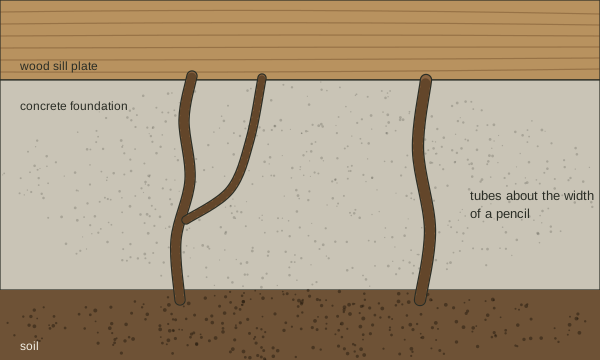
Termite treatment depends on which termites you have. Subterranean termites nest in the soil and travel into the house through mud tubes, so treatments target the soil around the foundation or use bait stations that the colony feeds on. Drywood termites nest inside dry wood with no soil contact, so treatments go into the infested wood or, when infestations are widespread or hidden, into the whole building through fumigation or heat.
All of these are jobs for a licensed pest-management professional. This page explains how each method works, what to expect and what to ask, without the product rates or application steps that belong on the label and with trained applicators.
Confirm the termite type first
The treatment plan follows from the species and where it is active. Subterranean termites leave mud tubes, darkened or blistered wood, and hollow galleries that follow the grain and often contain soil. Drywood termites push small, hard, six-sided fecal pellets out of tiny kickout holes, often leaving little piles below infested wood. Swarmers alone do not confirm an infestation in the house, since they can come from buried wood or stumps in the yard.
Our termite hub covers biology and species, and signs of termites shows what each kind of evidence looks like. UC IPM notes that a licensed professional should inspect before any treatment is chosen.
Soil-applied liquid termiticides
A liquid soil treatment is the most common way to protect a building from subterranean termites. The EPA describes it as a treated zone in the soil that termites must cross to reach the structure. Technicians apply termiticide along the foundation, under slabs and into foundation walls, using trenching, long soil-injection rods and drilling through concrete where needed.
Repellent and non-repellent products
Older termiticides were repellent. They kept foraging termites away from treated soil but did not necessarily kill them, so any gap in the barrier could let termites through. University of Kentucky Entomology explains that most modern liquid products are non-repellent: termites cannot detect them and tunnel into treated soil, picking up a lethal exposure. UC IPM notes that repellent products have largely been phased out in favor of non-repellent ones. Termites already inside the structure often die as well, since they can no longer get back to the soil for moisture.
How long liquid treatments last
UK Entomology says liquid termiticides should give at least five years of control when applied according to label directions, and Mississippi State Extension notes that better products may last 8 to 12 years or more. Results depend on the product, soil, climate, termite pressure and how thoroughly the job was done. No soil treatment lasts forever, which is why ongoing inspections and renewable service agreements exist.
If termites swarm indoors after treatment, it usually means they found an untreated gap rather than that the product failed. That is a call to the company, not a reason to panic.
Why liquid treatments need professionals
A full treatment can involve hundreds of gallons of diluted product placed into soil around and beneath a building. The EPA warns that improper application can contaminate the home and nearby drinking-water wells, and UC IPM notes the risk of getting product into ducts or plumbing. Soil type, slab construction, wells, drains and heating ducts all change how the job must be done. Some companies will not warrant a home where these features prevent a treatment to industry standards.
Termite baiting systems
Bait systems use cellulose material laced with a slow-acting insecticide, placed in plastic stations set into the soil around the house. Some stations go above ground over active mud tubes. Foraging termites feed on the bait and share it with nestmates, and the colony declines over time.
Many systems start with plain wood monitors. Once termites are found feeding, the technician swaps in active bait. UC IPM notes that the most effective baits use insect growth regulators, which stop termites from molting successfully and can suppress or eliminate the colony.
What to expect from baits
- They are slow. UK Entomology says termites may take weeks or months to find stations and months more to be controlled. UC IPM notes control can take months to years.
- They need servicing. Stations are checked on a schedule, and bait is added or replaced as needed. A bait system without regular monitoring is not a treatment.
- They are often combined. Mississippi State Extension notes that baits are usually not used alone against an active infestation. Known activity is often treated with a liquid, and baits then provide long-term protection.
Baits use small amounts of active ingredient compared with a soil treatment, and they suit sites where drilling or soil treatment is difficult. The trade-off is time and dependence on ongoing service.
Wood treatments with borates
Borate products are water-based wood treatments that soak into bare wood. The EPA notes they are often sprayed onto framing during new construction. Mississippi State Extension describes borates applied to the lower studs and sill plates before insulation and wall coverings go in.
Borates have limits. They are applied to exposed framing before walls are closed in, and Mississippi State Extension notes they are not used on wood that touches soil or is exposed to weather, because they leach out. In Mississippi, borates may not be used as a stand-alone pre-construction treatment and must be followed by an exterior soil treatment. They are a supplement to soil or bait treatment, not a replacement for it.
Drywood termite treatments
Because drywood termite colonies live entirely inside wood, soil treatments and in-ground baits do nothing for them.
Localized or spot treatments
When an infestation is small, accessible and accurately located, professionals may treat just the affected boards. UC IPM lists several approaches:
- Wood injection: liquids, foams or dusts placed into drilled holes in infested wood
- Electrical and microwave devices: results vary widely and depend on accurate detection
- Wood replacement: removing and replacing infested boards, which works only if every infested piece is found
The weakness of any spot treatment is that hidden colonies elsewhere in the structure go untreated. UC IPM notes that infestations can rebound and that home-use products are not effective for drywood termites.
Whole-structure fumigation
Fumigation, often called tenting, treats every colony in the building at once, including ones nobody has found. The structure is covered with tarps and filled with a gas fumigant that penetrates wood. UC IPM reports that fumigation is highly effective when done correctly, with monitored fumigation having the highest success rate. Occupants, pets and plants must leave for several days. The gas leaves no residual protection against future infestations.
Fumigation is a licensed specialty. UC IPM notes that some of the pesticides involved are restricted to licensed applicators, and Mississippi State Extension notes that only a few companies in that state perform tent fumigation. The company will give you a preparation list, which usually covers removing or bagging food, medicines and plants, arranging for pets and making the house accessible.
Whole-structure heat
Heat treatment raises the temperature of the wood throughout the structure high enough, and long enough, to kill termites inside. UC IPM notes that occupants usually need to leave for hours rather than days. Heat struggles to penetrate large beams and wood resting against concrete or tile, and it can damage heat-sensitive items such as plastics and some wiring. Like fumigation, it leaves no residue to protect against future colonies.
Pre-construction treatments
The easiest time to protect a building is before it is finished. Mississippi State Extension describes a typical liquid pretreatment as a soil treatment under the planned slab before the concrete is poured, followed by an exterior perimeter treatment after final grading. Depending on the state and product label, bait systems or borate framing treatments may also be used as pre-construction measures. Additions to an existing building need their own pretreatment.
The EPA lists building practices that help, such as concrete foundations, ventilation space between soil and wood, and physical barriers such as steel mesh or graded sand. If you are building, ask the builder in writing which termite pretreatment will be used and request the paperwork for your records.
Prevention that supports any treatment
Treatment works better and lasts longer when the house is less attractive to termites. University of Kentucky Entomology recommends:
- Keep wood siding and frames at least 6 inches (about 15 cm) above soil
- Direct water away from the foundation with gutters, downspouts and grading, and fix leaks
- Keep crawl spaces ventilated and dry
- Use mulch sparingly and keep it back from siding, doors and windows
- Store firewood, lumber and cardboard away from the foundation
Moisture and wood-to-soil contact are the conditions an inspector will flag, and many treatment warranties expect them to be corrected.
Inspections, monitoring and warranties
Termite control is ongoing. UC IPM suggests regular inspections for homes with past infestations. Many companies offer annual inspections as part of a renewable service agreement.
Warranty terms vary widely. UK Entomology notes that most companies will retreat affected areas at no extra charge if termites return, as long as the annual renewal is kept up. Some also offer to repair new damage, but it can be hard to prove when damage began. Spot treatments are usually not warranted, since termites may find other entry points.
Before you sign, read the contract for:
- Which areas and which termite species are covered
- Whether coverage is retreatment only or retreatment plus repair
- How often inspections happen and what the renewal costs
- Exclusions for moisture problems, inaccessible areas or later construction
- Whether the warranty transfers to a buyer if you sell
Home purchase inspections
A wood-destroying insect report for a home sale is a visual inspection of accessible areas. North Carolina’s agriculture department points out that it is not a guarantee that no infestation exists and does not assess the extent of damage. Damage evaluation belongs with a contractor or structural engineer.
Why DIY is limited for termites
UK Entomology says over-the-counter termite products rarely eliminate an existing infestation in a house, with exceptions such as a wooden post or similar item not attached to the structure. Here is why:
- Termites often enter at hidden points in and around the foundation, and finding them takes knowledge of building construction.
- Effective soil treatment needs drills, injection rods, large tanks and enough product to treat the soil continuously around and under the building.
- Drywood fumigation and some termite products are restricted to licensed applicators, and UC IPM notes that home-use products are not effective against drywood termites.
- Mistakes can contaminate the home or water supply, and partial treatments can leave gaps.
What homeowners can do well is prevention, watching for signs and keeping records. If you use any product labeled for termites on wood outside the house, read and follow the label. The EPA reminds users that applying a pesticide in a way that is inconsistent with its label violates federal law.
When to bring in a professional
Call a licensed professional if you see mud tubes on the foundation, swarmers emerging indoors, piles of drywood pellets, or damaged wood that contains soil or hollow galleries. Do the same if a wood-destroying insect report notes active termites.
Termites damage wood slowly, so you have time to get it right. UK Entomology recommends getting inspections and written proposals from more than one company and avoiding anyone who pushes you to sign on the spot. Verify the company’s license with your state’s structural pest control or agriculture regulator. Compare what each proposal treats, which method it uses and what the warranty covers. The EPA also suggests asking to see the product label, which should include directions for protecting structures from termites, and asking when it is safe to re-enter treated areas.
For more on vetting a company, see when to call a pest control professional.
References
- Termite Control: Answers for Homeowners (ENTFACT-604). University of Kentucky Entomology.
- Protecting Your Home Against Termites (ENTFACT-605). University of Kentucky Entomology.
- Subterranean and Other Termites: Pest Notes. University of California Statewide IPM Program.
- Drywood Termites: Pest Notes. University of California Statewide IPM Program.
- Methods of Termite Control. Mississippi State University Extension.
- Termites: How to Identify and Control Them. US Environmental Protection Agency.
- Homeowner's Guide to the Wood-Destroying Insect Report. North Carolina Department of Agriculture and Consumer Services.
- Introduction to Pesticide Labels. US Environmental Protection Agency.
See also
- Termites
- Signs of termites
- Termite vs flying ant
- When to call a pest control professional
- Pest control basics
This page was last updated on October 7, 2026. We research our guides from university extension services, government agencies, museums and peer-reviewed literature. Read the editorial policy or report an error.