Caterpillar Identification: How to Identify Common Caterpillars
Five clues, checked in order, will name most caterpillars you find in a yard or garden.
Quick answer
To identify a caterpillar, count its prolegs, note whether it is smooth, hairy or spiny, then match its color pattern, the plant it is eating, its size and the season. Do not touch hairy or spiny caterpillars you cannot name, because a few North American species sting.
Most caterpillars can be identified from five clues: the number of prolegs (the fleshy legs on the abdomen), whether the body is smooth, hairy or spiny, the color pattern, the plant it is eating, and its size and the time of year. Prolegs and body covering point to a family. Pattern and host plant usually settle the species.
Caterpillars are the larvae of butterflies and moths, the order Lepidoptera. They are one stage of complete metamorphosis: egg, larva, pupa and adult. Because a caterpillar molts about five times, the same species can look different at different ages.
Want something to carry outside? Download the printable Caterpillar Identification Guide (PDF). It covers anatomy, a family table, 15 species profiles, a field checklist and a glossary.
Quick answer: the five clues
| Clue | What to check | Why it helps |
|---|---|---|
| Prolegs | How many pairs on the abdomen, and where | Separates loopers, typical caterpillars, flannel moths and sawfly larvae |
| Body covering | Smooth, velvety, hairy, tufted, spiny or horned | Narrows to a family; flags possible stingers |
| Color pattern | Stripes, bands, spots, saddles, eyespots | Confirms species once the family is known |
| Host plant | The plant it is actually eating | Many species eat only one plant family |
| Size and season | Length, date and region | Rules out species that are not active then or there |
Check them roughly in that order. Color is the clue people reach for first, but it is the least dependable on its own.
Step-by-step: how to identify a caterpillar
Step 1: Decide whether it is safe to handle
If the caterpillar is hairy or spiny and you cannot name it, do not pick it up. Slide a leaf or a card under it, or photograph it where it is. Most fuzzy caterpillars are harmless, but the few that sting look soft and inviting.
Step 2: Count the prolegs
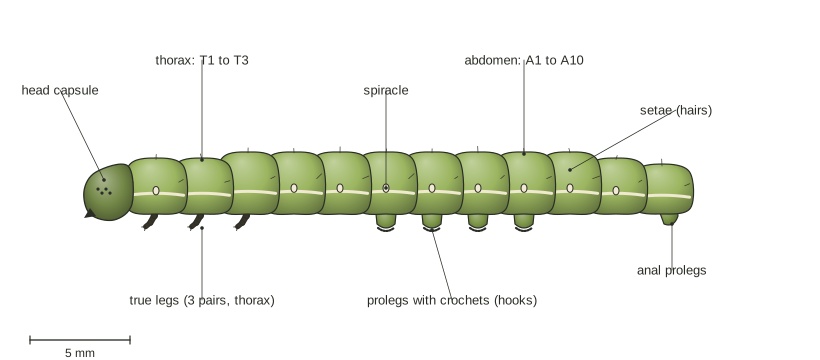
Find the three pairs of jointed legs just behind the head. Those are the true legs. Behind them, look for stubby, fleshy prolegs on the underside, plus a pair at the tail end.
- Five pairs (four mid-body pairs and a tail pair): the standard caterpillar plan. Hornworms, swallowtails, monarchs, woolly bears and tent caterpillars fit here.
- Two or three pairs: a looper. Inchworms (Geometridae) usually have two pairs. The cabbage looper and its relatives have three. Both arch the body as they walk.
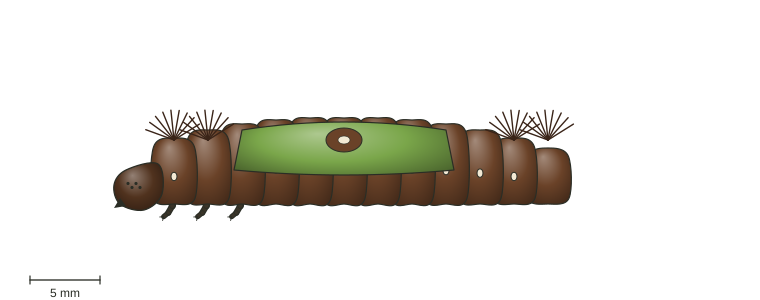
- Seven pairs and a coat of silky hair: a flannel moth caterpillar, such as the puss caterpillar. Treat it as a stinger.
- Six or more pairs on a mostly hairless larva: probably a sawfly larva, not a caterpillar. See the sawfly section below.
- No visible prolegs, slug-shaped: a slug caterpillar (Limacodidae). Several sting.
Step 3: Describe the body covering
Use plain words. Is it smooth and nearly bare, like a hornworm or cutworm? Velvety, like the imported cabbageworm? Densely hairy, like a woolly bear? Tufted with brushes and long pencils of hair, like a tussock moth? Studded with branched spines, like an io moth? Does it carry a single horn at the rear (a sphinx moth) or fleshy filaments at both ends (a monarch)?
Step 4: Note the color pattern
Record the main features: stripes running lengthwise, bands circling the body, diagonal side marks, rows of dots, a “saddle,” or false eyes. Look at the head color and any markings on the face. Photograph the side and the top in daylight.
Step 5: Identify the plant
A caterpillar on dill or parsley is very likely a black swallowtail. One on milkweed is probably a monarch or a queen. Cabbage-family crops draw the imported cabbageworm and cabbage looper. Tomatoes draw hornworms. Make sure it is eating that plant: fully grown caterpillars often wander to find a place to pupate.
Step 6: Measure and note the date and place
Length, season and region rule out many species. A web on a cherry tree in April is a different insect from a web on a pecan in September.
Step 7: Match to a family, then a species
Use the table below for common species. For anything else, match the family first. The printable guide has a family table covering 15 families.
Common caterpillars at a glance
| Caterpillar | Look for | Size | Usually found on | Notes |
|---|---|---|---|---|
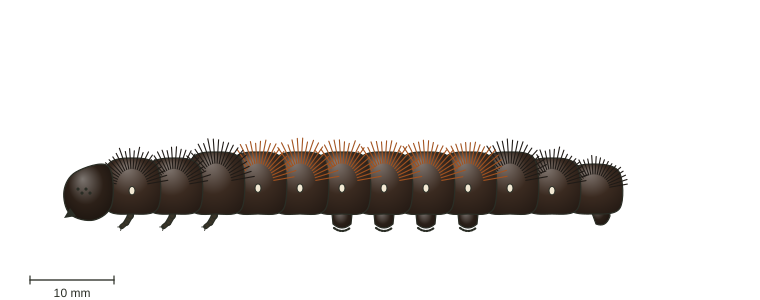
| Banded woolly bear | Dense bristles; black ends, rusty middle band | About 25 mm (1 in) | Plantain, dandelion, dock, grasses | Common in fall, crossing paths; harmless to most people |
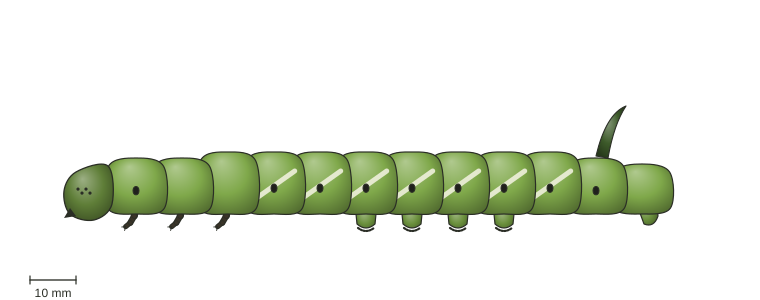
| Tomato hornworm | Green; white stripes along the sides; black horn at rear | 75 to 100 mm (3 to 4 in) | Tomato, pepper, eggplant, potato | Tobacco hornworm has a red horn |
| Eastern tent caterpillar | Black, white stripe down the back, blue and orange side marks | About 50 mm (2 in) | Wild cherry, apple, crabapple | Spring tents in branch forks |
| Fall webworm | Very hairy, yellowish or bluish black | About 38 mm (1 1/2 in) | Many fruit and shade trees | Late summer webs enclosing branch tips |
| Monarch | Black, yellow and white rings; two pairs of black filaments | Up to about 70 mm (2 3/4 in) | Milkweed | Queen caterpillar has a third pair of filaments |
| Black swallowtail | Green with black bands and yellow spots; young look like bird droppings | 38 to 50 mm (1 1/2 to 2 in) | Dill, parsley, fennel, carrot | Shows an orange forked scent organ when disturbed |
| Imported cabbageworm | Velvety green, faint yellow stripe | About 32 mm (1 1/4 in) | Cabbage, broccoli, kale | Larva of the cabbage white butterfly |
| Cabbage looper | Green, thin white lines; loops as it walks | About 30 mm (1 1/5 in) | Cabbage family, lettuce, many vegetables | Three pairs of prolegs |
| Spongy moth | Hairy; paired blue dots, then paired red dots down the back | Up to 75 mm (3 in) or more | Oaks and many other trees | Formerly called gypsy moth; renamed in 2022 |
| Hickory tussock moth | White with black markings and long white hairs | Medium | Hickory, walnut and other hardwoods | Barbed hairs can cause a rash |
| Polyphemus moth | Fat, pale green, accordion-shaped | Up to 100 mm (4 in) | Oak, maple, birch and other trees | Harmless |
| Io moth | Green with a red-and-white side stripe; clusters of spines | Up to 60 mm (2 1/3 in) | Many trees and shrubs | Stings |
| Saddleback | Green “saddle” with brown ends and spiny horns | About 20 mm (3/4 in) | Many trees, shrubs and ornamentals | Stings |
| Puss caterpillar | Teardrop of silky hair, tan to gray | 25 to 38 mm (1 to 1 1/2 in) | Oaks, elm, hackberry, pecan | Stings severely |
| Buck moth | Black with white flecks and branched spines | About 50 mm (2 in) | Oaks | Stings |
A note on the spongy moth: in March 2022 the Entomological Society of America adopted “spongy moth” as the common name for Lymantria dispar, dropping the old name because it is an ethnic slur against Romani people. The new name comes from the moth’s fuzzy, sponge-like egg masses. Older publications still use the former name.
Look-alike pairs and how to separate them
Several common caterpillars come in confusing pairs. These are the ones that trip people up most often.
Tomato hornworm vs tobacco hornworm. Both are big, green, and feed on tomatoes and peppers. The tomato hornworm has eight curved white side stripes and a straight black horn. The tobacco hornworm has seven diagonal white stripes and a curved red horn. Both are managed the same way, so the distinction matters mostly for curiosity.
Eastern tent caterpillar vs fall webworm. Timing and web position settle it. Tent caterpillars build thick tents in the forks of branches in spring, then leave the tent to feed. Fall webworms build loose webs that wrap around the ends of branches in summer and fall, and they feed inside the web.
Monarch vs queen vs black swallowtail. All three are boldly banded. The monarch and queen eat milkweed and carry soft black filaments; the queen has an extra pair in the middle of the body. The black swallowtail has no filaments, eats carrot-family plants, and pushes out an orange forked scent organ when poked.
Imported cabbageworm vs cabbage looper. Both are green and feed on cabbage-family crops. The cabbageworm is velvety with a faint yellow stripe and crawls normally on five pairs of prolegs. The looper has thin white lines and arches its back as it walks, because it has only three pairs.
Stinging caterpillars: what to avoid
A handful of North American caterpillars have hollow spines connected to venom glands. When a spine breaks against skin, it releases venom. Others carry barbed hairs that cause a rash without venom. All of the stinging species covered here are moth caterpillars.
The groups to know:
- Slug caterpillars: the saddleback, hag moth, spiny oak slug and stinging rose caterpillar. Short and fleshy, with spiny horns or lobes.
- Flannel moths: the puss caterpillar (southern flannel moth), sometimes called an “asp” in Texas. A soft-looking tuft of hair hides venomous spines. Its sting is often worse than other caterpillars’.
- Giant silk moths: the io moth and buck moth, both covered in branched spines.
- Tussock and tiger moths: the spongy moth, white-marked tussock moth and hickory tussock moth carry irritating hairs. Reactions vary from person to person.
Most stings happen when someone brushes against leaves where the caterpillars are feeding. Symptoms range from itching and redness to burning pain, swelling, blisters, headache and nausea. Puss caterpillar stings can cause pain that spreads up the arm.
Prevention is mostly habit. Wear gloves and long sleeves when pruning shrubs in late summer and fall, look at the leaves before you reach in, and teach children to leave fuzzy and spiny caterpillars alone.
Caterpillar or sawfly larva?
Sawflies are plant-feeding relatives of wasps in the order Hymenoptera. Their larvae look so much like caterpillars that most gardeners never notice the difference. It matters, though, because Bt (Bacillus thuringiensis) sprays made for caterpillars do not work on sawfly larvae.
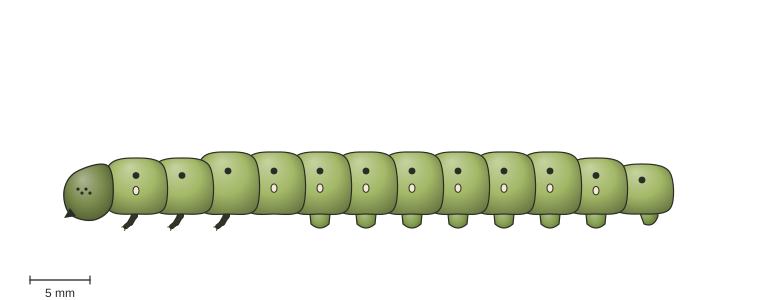
| Trait | Caterpillar | Sawfly larva |
|---|---|---|
| Pairs of prolegs | 5 or fewer (flannel moths have 7) | 6 or more |
| Tiny hooks on prolegs | Yes | No |
| Eyes on each side of head | Usually 4 to 6 | 1 |
| When disturbed | Varies | Groups often rear up together in an S shape |
The quickest field test is a proleg count. If you have a hand lens, the hooks (crochets) on caterpillar prolegs and the single eye on a sawfly’s head confirm the call.
When caterpillars are garden pests
Most caterpillars in a yard do little lasting harm, and many become butterflies people want to see. A few build up on food crops and ornamentals. The usual suspects:
- Vegetable garden: tomato and tobacco hornworms on tomatoes and peppers, and imported cabbageworms and cabbage loopers chewing holes in broccoli, cabbage and kale.
- Trees and shrubs: eastern tent caterpillars in spring, fall webworms in late summer, bagworms on arborvitae and juniper, and spongy moth outbreaks in oak forests.
- Lawns: fall armyworms in late summer and fall.
Signs of caterpillar feeding are ragged holes or missing leaf edges, stripped stems, and small dark pellets of droppings (frass) on the leaves or ground below.
Before you treat, confirm what you have and how much damage it is doing. Healthy trees usually recover from tent caterpillar and webworm feeding. Hornworms carrying small white cocoons are parasitized by a wasp and should be left alone. Handpicking works well for large, easy-to-see caterpillars such as hornworms. Where a treatment is needed, Bt products work best on young caterpillars and are easier on natural enemies than broad-spectrum sprays. Read and follow the label, and confirm the plant is listed on it.
The garden pests guide covers caterpillars alongside aphids, beetles, true bugs and the other insects that feed on vegetables, lawns, trees and houseplants.
Get the printable guide
The web page covers the essentials. The printable version goes further, with labeled anatomy, a proleg counting guide, a family table, 15 detailed species profiles, a field checklist and a 40-term glossary, all formatted for a clipboard or classroom.
Download the printable Caterpillar Identification Guide (PDF)
References
- Caterpillars in Your Yard and Garden (IPM1019). University of Missouri Extension.
- Sawflies. University of Wisconsin-Madison Extension.
- Stinging Caterpillars (ENTFACT-003). University of Kentucky Entomology.
- Caterpillar Stings. Poison Control, National Capital Poison Center.
- Asps and Other Stinging Caterpillars. Texas A&M AgriLife Extension.
- Fall Webworm and Eastern Tent Caterpillar. University of New Hampshire Extension.
- Spongy Moth. Entomological Society of America.
- Tomato hornworm and tobacco hornworm. Texas A&M AgriLife Extension.
See also
- Caterpillar Identification Guide (printable PDF)
- Garden pests: identifying the insects on your plants
- Complete metamorphosis
- The orders of insects
- Hymenoptera: ants, bees, wasps and sawflies
This page was last updated on October 7, 2026. We research our guides from university extension services, government agencies, museums and peer-reviewed literature. Read the editorial policy or report an error.