Ant Control and Prevention: Finding and Treating the Colony
Ants you see are a small fraction of the colony. Lasting control means reaching the nest, usually with baits the workers carry home.
Quick answer
To control ants, identify the species, follow the trail to find where ants are entering and nesting, clean up the scent trail and food sources, and use slow-acting baits that workers carry back to the colony. Sprays kill only the ants they touch and can cause some species to split into new colonies. Carpenter ants need their nest found and moisture problems fixed, and fire ants in yards are often managed with a two-step bait and mound treatment.
Ant control works when it reaches the colony, not just the ants on the counter. Start by identifying the species, then follow the trail to find where ants are coming in and, if possible, where they nest. Clean up the trail and the food that drew them, seal entry points, and use slow-acting baits that workers carry back to share with the queens and young. Sprays mostly kill the foragers you can see, and with some species they make the problem harder to solve.
This page explains each step. It does not give product rates. Read and follow the label on any product you use.
Identify the ant first
Ant species differ in what they eat, where they nest and how they respond to treatment. A sweet-feeding trail ant in the kitchen, a carpenter ant pushing sawdust out of a window frame and a fire ant mound in the lawn each need a different plan.
Start with these clues:
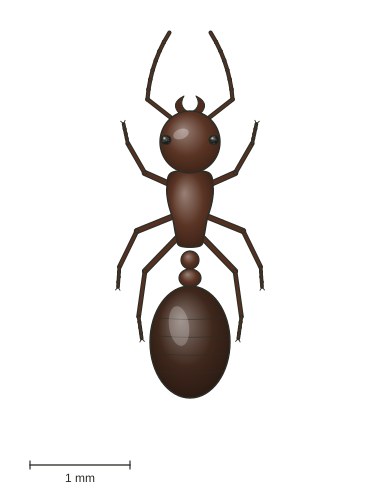
- Size and color. Many common indoor trail ants are tiny, about 3 mm (1/8 inch). Carpenter ant workers are large, about 6 to 13 mm (1/4 to 1/2 inch).
- What they are eating. Sweets, grease, protein or pet food.
- Where they nest. In soil outside, under slabs, in wall voids or in damp wood.
- Winged ants. Swarms indoors can mean a nest inside. Make sure they are ants and not termites, which have straight antennae and a broad waist. See termite vs flying ant.
Our ants hub covers the common household species. Your county extension office can also identify a specimen.
Follow the trail
Most indoor ants arrive along a scent trail from an outdoor nest. Watching that trail is the fastest way to find the entry point.
- Watch where ants come and go, ideally when they are most active.
- Follow the line back to a crack, window frame, pipe opening or gap along the baseboard.
- Look outside at the matching spot for a nest in soil, mulch, under stones or along the foundation.
UC IPM notes that a few stray ants are usually scouts looking for food. A steady trail means the colony has found something worth returning to.
Clean and seal
Once you know the route, remove the reason for it and close the door.
- Wipe the trail. UC IPM recommends wiping trails with soapy water or vacuuming them up. That removes the scent ants follow.
- Remove food. Wipe counters, store sweets and pet food in sealed containers, rinse recyclables and empty kitchen trash often.
- Seal entry points. Caulk cracks around the foundation, windows, pipes and wires. UC IPM notes that petroleum jelly can plug a small opening as a short-term fix.
- Fix moisture. Leaks and condensation attract many species.
For a small, recent invasion, these steps alone sometimes end the problem.
Baits versus sprays
How baits work
An ant bait combines an attractive food with a slow-acting insecticide. Foraging workers carry it back and share it through the colony, which can kill the queens and brood that never leave the nest. UC IPM considers prepackaged bait stations the easiest and safest option for homeowners.
To get the most from baits:
- Place stations along active trails and near entry points, out of reach of children and pets.
- Match the bait to what the ants are eating. UC IPM suggests offering more than one bait type to see which the ants prefer.
- Do not spray insecticides or cleaners around bait placements while baiting.
- Be patient. UC IPM notes results can take several days to a week or more.
- Replace or move stations that ants are not visiting.
Read the label before you buy and before you place any bait. It lists the pests, sites and precautions the product is approved for. The EPA notes that using a pesticide in a way that conflicts with its label violates federal law, a rule often summed up as “the label is the law.”
Why sprays can backfire
Sprays kill the ants they touch, but the colony keeps sending replacements. UC IPM notes that indoor sprays give only temporary relief and do not stop more ants from entering.
With some species, sprays create a bigger problem. Pharaoh ants, which have many queens per colony, can split into several new colonies when disturbed, a process called budding. Researchers testing simulated barrier treatments on pharaoh ant colonies found that a repellent pyrethroid triggered budding, while non-repellent treatments did not. The authors advised against using repellent sprays to eliminate indoor pharaoh ant colonies. A kitchen spray against tiny ants can turn one colony into several, all harder to reach.
Outdoor and perimeter measures
Most indoor ant problems start outside. Reducing ant pressure around the foundation helps:
- Trim shrubs and branches that touch the house, since ants use them as bridges.
- Keep mulch and soil from piling against siding.
- Move firewood, stones and debris away from the foundation.
- Manage honeydew-producing insects such as aphids and scales on plants near the house. UC IPM notes that many ants feed on that sugary waste.
- Place bait stations outdoors near nests and along trails leading to the house.
Residual perimeter sprays around foundations are widely used, but UC IPM notes they do not eliminate colonies and can wash into storm drains and waterways. California has restricted their use for that reason. If you or a professional use one, it should support baiting and sealing rather than replace them, and it must follow the label.
Carpenter ants
Carpenter ants do not eat wood the way termites do, but they hollow it out to build nests, and over time that can weaken it. They favor wood that is or has been damp.
Signs of an indoor nest
The University of Minnesota Extension lists these signs:
- Seeing 20 or more workers indoors on a regular basis
- Piles of coarse sawdust (frass) with insect parts below wood
- Winged ants indoors from late winter through spring
- A faint rustling sound inside a wall or wood that gets louder when disturbed
Finding the nest
Carpenter ants are most active at night. Minnesota Extension suggests watching for workers between sunset and midnight in spring and summer using a flashlight covered with red film, since ants do not see red light well. Setting out a bit of tuna packed in water or something sweet near activity and following workers back is another approach. Tapping suspect wood and listening can also help.
Indoor nests are often satellite colonies connected to a parent colony outdoors in a stump, dead tree, log or fence post. Finding and dealing with both matters.
Fixing the cause
Check for leaks around tubs, sinks and dishwashers, under roofing, in attic framing and around windows and doors. Replace moisture-damaged wood, store firewood away from the house, remove stumps and trim branches that touch the roof.
Minnesota Extension notes that spraying foraging workers rarely eliminates a nest. Baits placed where workers are active can work over weeks to months. Wall-void dust treatments should be left to professionals. Minnesota Extension adds that most carpenter ant problems benefit from a professional, since nests are hidden and control is complex.
Fire ants in the yard
Red imported fire ants sting repeatedly when their mound is disturbed. Texas A&M AgriLife Extension notes that stings are rarely life-threatening, but some people become sensitive to them and should see an allergist. Get emergency care right away for chest pain, trouble breathing, serious swelling or slurred speech after a sting. For heavily infested yards, Texas A&M recommends a two-step method.
Step 1: Broadcast a bait
A fire ant bait is spread over the whole yard so foraging workers carry it back to their colonies, where it reaches the queen. Texas A&M notes that late summer to early fall is a good time, when ants are actively foraging. Baits work best when fresh, applied to dry ground with no rain expected, at a time of day when workers are foraging. Baits are slow, taking weeks to months to reach high levels of control.
Step 2: Treat problem mounds
Mounds in high-traffic spots, such as near play areas or doors, can be treated individually with a product labeled for mound treatment. Texas A&M emphasizes not disturbing the mound, since that causes ants to scatter and relocate.
Follow the label for every product, including timing, amounts and how long to keep children and pets off treated areas. Texas A&M reports that pouring very hot water on a mound kills the colony only about 60% of the time and also kills grass and plants it touches. It can scald the person pouring, too.
When to bring in a professional
Many trail ant problems can be handled with cleaning, sealing and baits. A professional is a reasonable call when:
- You find carpenter ant frass or nests in walls, or ant activity alongside wood damage that needs to be told apart from termites
- Ants persist after several weeks of consistent baiting and sealing
- You suspect pharaoh ants or another budding species, especially in a multi-unit building, hospital or food business
- Fire ants are near someone with a known sting allergy, or the area is too large to manage
A good company identifies the species, finds the nest or entry points and explains why it chose baits, non-repellent products or other methods. Ask what it will treat, how it will measure success and what you should change around the house. For vetting tips, see when to call a pest control professional.
References
- Ants: Pest Notes. University of California Statewide IPM Program.
- Carpenter Ants. University of Minnesota Extension.
- Two-Step Method. Texas A&M AgriLife Extension, Texas Imported Fire Ant Research and Management Project.
- Medical Information. Texas A&M AgriLife Extension, Texas Imported Fire Ant Research and Management Project.
- Efficacy of Simulated Barrier Treatments Against Laboratory Colonies of Pharaoh Ant. Journal of Economic Entomology (Buczkowski et al., 2005), hosted by Purdue University.
- Introduction to Pesticide Labels. US Environmental Protection Agency.
- Integrated Pest Management (IPM) Principles. US Environmental Protection Agency.
See also
- Ants
- Termite vs flying ant
- Bugs in the kitchen
- Pest control basics
- When to call a pest control professional
This page was last updated on October 7, 2026. We research our guides from university extension services, government agencies, museums and peer-reviewed literature. Read the editorial policy or report an error.