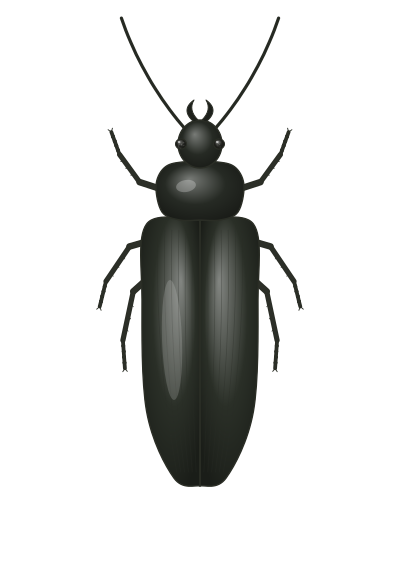
Hemiptera (True Bugs): Identification, Characteristics & Families
Stink bugs, bed bugs, cicadas, aphids and scale insects all belong to one order. What unites them is a beak built for piercing and sucking.
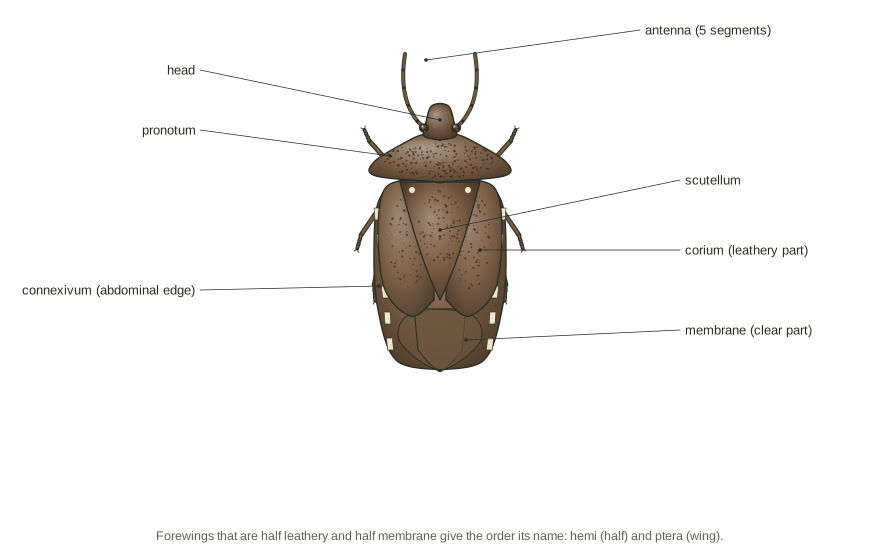
Hemiptera is the order of true bugs and their relatives. The single trait every member shares is the mouth: a slender, jointed beak that carries needle-like stylets for piercing plant or animal tissue and sucking out fluid. They also share simple metamorphosis, in which young nymphs look like small, wingless versions of the adult.
The order is large and varied. It holds stink bugs, assassin bugs and bed bugs, but also cicadas, leafhoppers, aphids, whiteflies and scale insects. If you studied from an older textbook, you may know that second set as the order Homoptera. That name is no longer used as an order, and this page explains why.
What is a true bug
In everyday speech, “bug” means any small crawling creature. In entomology, a bug is a member of Hemiptera, and “true bug” narrows it further to the suborder Heteroptera: stink bugs, squash bugs, assassin bugs, bed bugs, water striders and their kin.
Three traits mark a true bug in the field.
- A beak, not jaws. The mouthparts form a tube (the rostrum or beak) that starts at the front of the head and folds back under the body between the legs when not in use. Beetles, by contrast, have side-to-side chewing jaws.
- Half-hardened front wings. In most true bugs the front wings are thickened and leathery at the base and thin and membranous at the tip. These are called hemelytra, and the order name (Greek for “half wing”) comes from them. At rest the wings lie flat on the back and the membranous tips overlap, forming an X or a diamond near the rear.
- A triangular scutellum. Behind the pronotum (the shield behind the head) sits a triangular plate, the scutellum. In stink bugs and shield bugs it is large and easy to see.
Many true bugs also have scent glands on the thorax. That is the source of the stink in stink bugs, and of the musty smell of a heavy bed bug infestation.
True bug or beetle?
Beetles are the insects most often confused with true bugs. The table shows the quick checks.
| Trait | True bug (Heteroptera) | Beetle (Coleoptera) |
|---|---|---|
| Mouthparts | Jointed beak folded under the body | Chewing jaws |
| Front wings | Leathery base, membranous tip; tips overlap | Fully hardened elytra meeting in a straight line |
| Scutellum | Often large and obvious | Usually tiny |
| Young | Nymphs look like small adults, no pupa | Larvae look nothing like adults; pupa stage |
See our Coleoptera page for the beetle side of the comparison, and the orders of insects for all the major groups.
The piercing-sucking beak
Every hemipteran feeds on fluid. Most drink plant sap. Others take the body fluids of other insects, and a few, such as bed bugs and kissing bugs, feed on vertebrate blood.

The visible beak is the labium, usually three or four segments long. It does not pierce anything itself. It is a sheath that guides and protects four slender stylets inside it:
- Two mandibular stylets on the outside, which are the main piercing tools.
- Two maxillary stylets in the middle, which lock together to form two tubes: a food canal that carries fluid up into the head and a salivary canal that carries saliva down.
During feeding, only the stylets enter the host. The labium bends or folds back out of the way. Saliva flowing down the salivary canal does different jobs in different groups. Predators and some plant-feeding true bugs use it to liquefy tissue before sucking it up. Aphids, cicadas, hoppers and other sap feeders lay down a sheath of hardened saliva around the stylets as they probe toward the sap-carrying tissue.
Where the beak attaches is a useful clue to the suborder. In true bugs it arises from the front of the head. In cicadas and hoppers it arises from the rear underside of the head. In aphids, scales and whiteflies it appears to come from between the front legs.
For a comparison with mosquito, flea and fly mouthparts, see insect mouthparts.
Wings: hemelytra and uniform wings
Wing structure divides the order roughly in two.
- Heteroptera (true bugs) have hemelytra: front wings with a hardened base and a membranous tip, held flat over the back. “Heteroptera” means “different wings,” referring to the two textures in one wing.
- Auchenorrhyncha and Sternorrhyncha (cicadas, hoppers, aphids, scales, whiteflies, psyllids) have front wings of the same texture throughout, either all membranous or evenly thickened. At rest they are usually held sloped like a roof over the body. This uniform wing was the source of the old name “Homoptera,” meaning “same wings.”
Many hemipterans have reduced wings or none at all. Bed bugs have only tiny wing pads and cannot fly. Many aphids in a colony are wingless; most species produce winged adults when colonies get crowded or food quality declines. Female scale insects never develop wings.
Simple metamorphosis
Hemipterans develop through simple (incomplete) metamorphosis: egg, then a series of nymphs, then adult. There is no pupa. Nymphs feed the same way as adults, often on the same host, and gain wing pads that grow larger with each molt. See simple and incomplete metamorphosis for how this compares with other orders.
Aphids add a twist. In mild weather many species reproduce without mating, and females give birth to live young. A nymph can mature in about a week in warm conditions, which is why aphid colonies can build up so quickly.
Suborders of Hemiptera
Hemiptera is usually split into four suborders. The table summarizes them.
| Suborder | Familiar members | Beak arises from | Wings |
|---|---|---|---|
| Heteroptera | Stink bugs, bed bugs, assassin bugs, plant bugs, squash bugs, water striders | Front of the head | Hemelytra held flat |
| Auchenorrhyncha | Cicadas, leafhoppers, treehoppers, spittlebugs, planthoppers | Rear underside of the head | Uniform, held roof-like |
| Sternorrhyncha | Aphids, scale insects, mealybugs, whiteflies, psyllids | Between the front legs | Uniform, often reduced or absent |
| Coleorrhyncha | Moss bugs (one family, Peloridiidae) | Appears to arise from the thorax | Reduced |
Heteroptera are the true bugs. They include plant feeders, predators, blood feeders and many aquatic species. Antennae usually have four or five segments.
Auchenorrhyncha means roughly “neck beak,” for the beak’s position at the back of the head. Members have short, bristle-like antennae and three-segmented feet, and many are strong jumpers. Nearly all feed on plant sap. Males of the group produce vibration signals to attract mates; in cicadas those signals are loud enough to hear across a neighborhood.
Sternorrhyncha are mostly small, soft-bodied and often sedentary plant feeders with longer, thread-like antennae. They include many of the most serious plant pests, and many spread plant viruses.
Coleorrhyncha are a tiny, ancient group of moss-dwelling bugs found in parts of Australia, New Zealand and South America. No North American reader is likely to meet one.
Homoptera: the old order explained
If you see “Homoptera” in a textbook, a field guide or an older website, it refers to the cicadas, hoppers, aphids, scales, whiteflies and psyllids. Many 20th-century textbooks treated these insects as a separate order, set apart from the true bugs by their uniform wings and rear-set beaks.
Later studies showed that Homoptera is not a natural group. Some “homopterans” are more closely related to true bugs than to other homopterans. A group defined that way, which leaves out some descendants of the common ancestor, is called paraphyletic, and modern classification avoids it. So Homoptera was dropped, and its members were folded into Hemiptera as the suborders Auchenorrhyncha and Sternorrhyncha.
What this means for readers:
- “Homoptera” and “homopterans” are still fine as informal shorthand for sap-feeding hoppers, aphids and scales, but not as a formal order.
- An aphid or cicada labeled “Homoptera” in an old source is “Hemiptera” today. Nothing about the insect changed.
- Sources that give Hemiptera about 40,000 species are counting only the true bugs. The order in its current sense is much larger: roughly 110,000 described species worldwide, with estimates of about 200,000 in total, and around 10,000 species in North America.
Major families of Hemiptera
The families below are the ones most often seen in homes, gardens and fields in the United States.
| Family | Common name | How to spot it | Pest relevance |
|---|---|---|---|
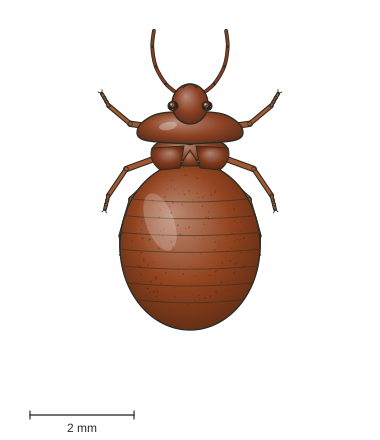
| Cimicidae | Bed bugs | Flat, oval, reddish brown, flightless; adults average about 5 mm | Blood feeders in homes |
| Pentatomidae | Stink bugs | Shield-shaped; very large triangular scutellum; scent glands | Crop pests; brown marmorated stink bug invades homes in fall |
| Reduviidae | Assassin bugs, kissing bugs | Narrow head, often with a “neck”; stout curved beak | Mostly beneficial predators; kissing bugs feed on blood |
| Miridae | Plant bugs | Small, soft-bodied, often green or brown | Tarnished plant bug; some species are predators |
| Coreidae | Leaf-footed and squash bugs | Long, often brownish; some have leaf-like flares on hind legs | Squash bug on cucurbits |
| Lygaeidae and relatives | Seed bugs, chinch bugs | Small to medium; many feed on seeds | Chinch bugs in turf; bigeyed bugs are predators |
| Rhopalidae | Scentless plant bugs | Similar to seed bugs | Boxelder bug invades homes in fall |
| Cicadidae | Cicadas | Large, broad head, wide-set eyes, clear veined wings | Egg-laying damages young twigs |
| Cicadellidae | Leafhoppers | Small, slender, wedge-shaped; jump readily | Sap feeders on many plants |
| Aphididae | Aphids | Soft, pear-shaped; most have two tailpipes (cornicles) | Sap feeding, honeydew, plant viruses |
| Coccoidea (superfamily) | Scale insects, mealybugs | Adults look like bumps or waxy fluff; often no visible legs | Sap feeding and honeydew on trees, shrubs and houseplants |
| Aleyrodidae | Whiteflies | Tiny, with powdery white wax on four wings | Sap feeding, honeydew, plant viruses |
| Psylloidea (superfamily) | Psyllids, jumping plant lice | Tiny, active, jumping sap feeders | Sap feeding on trees, shrubs and crops |
Bed bugs (Cimicidae)
The common bed bug, Cimex lectularius, is a flat, oval, reddish-brown insect that feeds only on blood. Adults average about 5 mm (1/5 inch) long, and they swell and redden after feeding. Their wings are reduced to small pads, and they cannot fly. Bed bugs hide during the day in mattress seams, box springs, bed frames, headboards, furniture joints and cracks, and come out at night to feed on sleeping people.
A female lays about 200 eggs over her life. Nymphs need a blood meal before each molt, pass through five molts, and can reach adulthood in about 10 weeks. Bed bugs can survive several months between meals. The CDC notes they are not known to spread disease, though bites can itch, disturb sleep and occasionally become infected from scratching.
Practical next steps:
- Learn the evidence: rusty spots, shed skins and eggs along seams are covered on signs of bed bugs.
- Confirm the insect. Small brown insects near beds are often fleas or carpet beetles. Our flea vs bed bug and carpet beetle vs bed bug comparisons help separate them.
- Read the bed bugs hub for biology, prevention and treatment options.
Stink bugs (Pentatomidae)
Stink bugs are shield-shaped, with a very large triangular scutellum and scent glands that release a strong odor when the bug is disturbed or crushed. Most feed on plants, though a few species are predators of other insects.
The brown marmorated stink bug (Halyomorpha halys) is native to East Asia and was first collected in the US in Allentown, Pennsylvania, in 1998. It has since spread widely. Adults are about 17 mm (2/3 inch) long, mottled brown, with light bands on the antennae and dark bands on the membranous wing tips. It feeds on many fruits, vegetables and field crops, leaving scarred, dimpled apples and spongy patches in tomatoes and peppers.
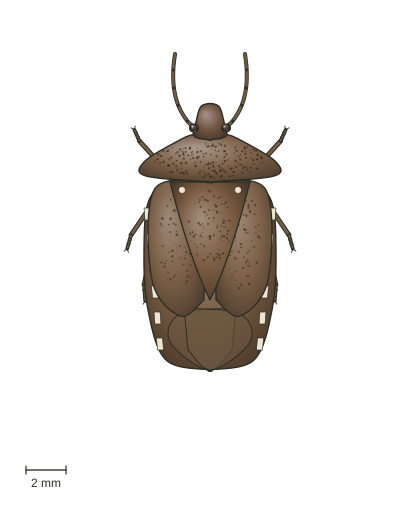
In September and October, adults gather on the outside of houses on warm days and push indoors through gaps to spend the winter. They do not reproduce indoors and do not damage the structure, but large numbers are a nuisance, and their odor can cling to anything that crushes them, including a vacuum cleaner. Sealing gaps around windows, siding, vents and utility lines before fall is the main prevention.
Assassin bugs and kissing bugs (Reduviidae)
Assassin bugs are predators with a long, narrow head, a stout curved beak and often a distinct “neck” behind the eyes. They ambush or stalk other insects and inject saliva that subdues and liquefies the prey. Wheel bugs, with a cog-like crest on the thorax, are a familiar large species. Assassin bugs can deliver a painful bite if handled, so it is best to move them with a container rather than bare hands.
Kissing bugs (triatomines) are a blood-feeding subgroup of Reduviidae. The facts below come from the CDC.
- Kissing bugs can carry the parasite Trypanosoma cruzi, which causes Chagas disease. The parasite is passed in the bug’s feces, not through the bite itself. Infection happens when feces get rubbed into the bite wound, another break in the skin, the eyes or the mouth.
- The bugs hide during the day and feed at night.
- Chagas disease is mainly found in rural parts of Mexico, Central America and South America. Eleven species of kissing bugs have been reported in the southern United States.
- Outdoors in the US they live in places such as rodent nests, animal burrows, chicken coops, dog houses and under porches. Infestations in US homes are rare.
- Wheel bugs and leaf-footed bugs look similar but do not carry the parasite.
If you think you have found a kissing bug, a local health department or university extension office can help confirm the identification. Anyone concerned about a possible exposure should talk with a doctor.
Plant bugs (Miridae)
Miridae is a large family, with about 1,750 species in North America. Most are small and soft-bodied. The great majority feed on plants, and the tarnished plant bug is a familiar pest of many crops and garden plants. Some mirids are predators.
Leaf-footed and squash bugs (Coreidae)
Coreids are medium to large, often brown, and many species have flattened, leaf-like expansions on the hind legs. The squash bug (Anasa tristis) is a major garden pest of squash and pumpkins. Adults reach about 16 mm (5/8 inch), lay bronze egg clusters on leaf undersides, and feed with their beaks to cause yellow spots that turn brown and wilt young plants.
Seed bugs, chinch bugs and boxelder bugs
Older classifications lumped many small seed-feeding bugs into one large family, Lygaeidae. That family has since been split. Many seed bugs remain in Lygaeidae, but chinch bugs, once treated as lygaeids, now have their own family (Blissidae) within the same superfamily, Lygaeoidea. Chinch bugs damage turf and small grains. Bigeyed bugs, also traditionally grouped with the lygaeids, are useful predators.
The boxelder bug (Boisea trivittata) belongs to a separate family, Rhopalidae, the scentless plant bugs. Adults are about 11 to 14 mm (roughly 1/2 inch) long and black with red markings. They feed mainly on boxelder and other maples, especially the seeds of female boxelder trees. In fall, adults gather on sunny walls and move into cracks in buildings to overwinter, sometimes ending up indoors. They are not a health threat, but they can leave spots on furniture and light-colored materials, and like stink bugs they can turn up indoors in large numbers.
Cicadas, leafhoppers and other hoppers
The Auchenorrhyncha include some of the largest and some of the smallest members of the order. More than 42,000 species have been described worldwide.

Cicadas (Cicadidae) spend most of their lives underground as nymphs, feeding on sap from plant roots. Annual cicadas emerge every summer. Periodical cicadas emerge as adults in huge, synchronized broods 13 or 17 years after they hatched, in parts of the eastern United States. Only males sing, using drum-like organs called tymbals on the first abdominal segment. Adults live about two weeks and do little feeding damage, but females cut slits in young twigs to lay eggs, which can cause the tips to wilt and brown (called flagging). Small, newly planted trees are the most at risk.
Leafhoppers (Cicadellidae) are small, slender and wedge-shaped, and they jump readily. They are among the most diverse families of the order, with over 2,500 species in North America. They feed on sap from a wide range of plants.
Treehoppers (Membracidae) have an enlarged pronotum that extends back over the body, often in thorn- or horn-like shapes. Spittlebugs (Cercopoidea) and planthoppers (Fulgoroidea) round out the suborder.
Aphids, scales, whiteflies and psyllids
The Sternorrhyncha are the small sap-feeders that gardeners know best. Four groups matter most.
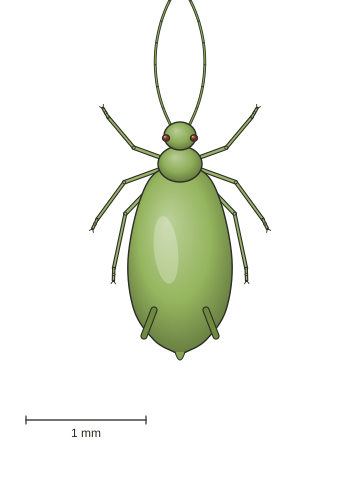
Aphids (Aphididae). Small, soft and pear-shaped, often green, black, yellow or pink. Most species have a pair of tube-like cornicles near the rear. Their long mouthparts pierce tender tissue and suck sap from the phloem. During warm weather many species reproduce without mating, and females give birth to live young that can mature in about a week. Winged forms appear when colonies crowd or plants decline. Aphids excrete honeydew, a sticky sugary waste that grows black sooty mold and attracts ants, which guard aphids from predators.
Scale insects (Coccoidea). Adult females lose their legs and settle permanently on bark, leaves or fruit, looking more like bumps than insects. Only the first-stage nymph, called a crawler, moves around. Armored scales sit under a removable waxy cover and do not produce honeydew. Soft scales are larger and rounded, the cover is the insect’s own body, and they produce honeydew. Mealybugs are related scale insects coated in white wax.
Whiteflies (Aleyrodidae). Not true flies. Adults are tiny, with a yellowish body and a powdery white wax coating on four wings. The flat, immobile nymphs on leaf undersides cause most of the damage. Whiteflies produce honeydew, and some species transmit viruses to vegetable crops.
Psyllids (Psylloidea). Tiny jumping sap feeders, sometimes called jumping plant lice, that live on trees, shrubs and some crops.
Ecology and pest relevance
Hemiptera play many roles. Some families are serious crop pests, others are important predators, and many are simply part of the food web for birds, spiders and other insects.
Plant feeders. Heavy sap feeding can yellow leaves, distort new growth and stunt plants, though most established plants tolerate light infestations. The honeydew from aphids, soft scales and whiteflies supports black sooty mold on leaves, cars and patios below. Some aphids and whiteflies also spread plant viruses. Our garden pests section covers identification and control.
Predators. Assassin bugs, bigeyed bugs, predatory plant bugs and a few stink bugs feed on other insects, including garden pests. Broad-spectrum insecticides kill these allies along with the pests, which is one reason extension services often favor targeted options such as insecticidal soaps and oils for aphids.
Water bugs. Water striders skate on the surface film, while backswimmers, water boatmen and giant water bugs live in ponds and streams. Most are predators.
Household pests. Only a small number of hemipterans matter indoors: bed bugs (blood feeders), kissing bugs (rare in US homes), and the stink bugs and boxelder bugs that move indoors in fall to overwinter. Houseplants can also host aphids, mealybugs, scales and whiteflies.
Damage clues. Because hemipterans suck fluids instead of chewing, they leave no holes or ragged edges. Look instead for stippling (tiny pale dots), yellowing, curled or distorted leaves, sticky honeydew and black sooty mold. Our insect mouthparts page shows how to read the difference between chewing and sucking damage.
References
- Order Hemiptera: True Bugs, Cicadas, Hoppers, Aphids and Allies. BugGuide (Iowa State University).
- Hemiptera lecture notes (Insect Systematics). North Dakota State University.
- Aphids: Pest Notes. University of California IPM.
- Order Hemiptera. NC State University, General Entomology.
- Common Bed Bug, Cimex lectularius. University of Florida IFAS, Featured Creatures.
- Periodical and Annual Cicadas. Ohio State University Extension.
- How Chagas Disease Spreads. Centers for Disease Control and Prevention.
- About Bed Bugs. Centers for Disease Control and Prevention.
- Brown Marmorated Stink Bug. Penn State Extension.
- Boxelder Bug. Utah State University Extension.
- Boisea trivittata: Eastern Boxelder Bug. BugGuide (Iowa State University).
See also
- The orders of insects
- Insect mouthparts
- Simple metamorphosis
- Bed bugs
- Coleoptera: beetles
- Garden pests
This page was last updated on October 7, 2026. We research our guides from university extension services, government agencies, museums and peer-reviewed literature. Read the editorial policy or report an error.