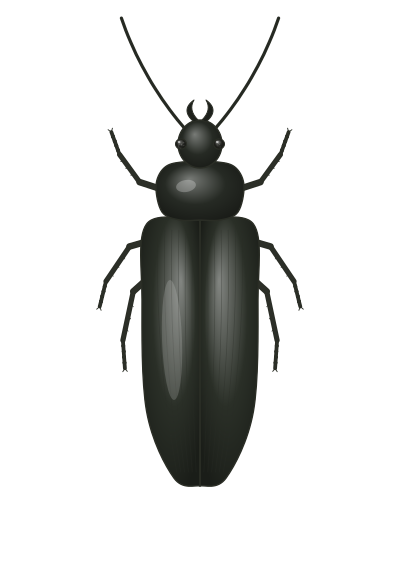
Insect Mouthparts: Chewing, Piercing-Sucking, Siphoning and Sponging
Every insect mouth is built from the same handful of parts. Rearranging them has produced jaws, beaks, straws and sponges, and each leaves its own kind of damage.
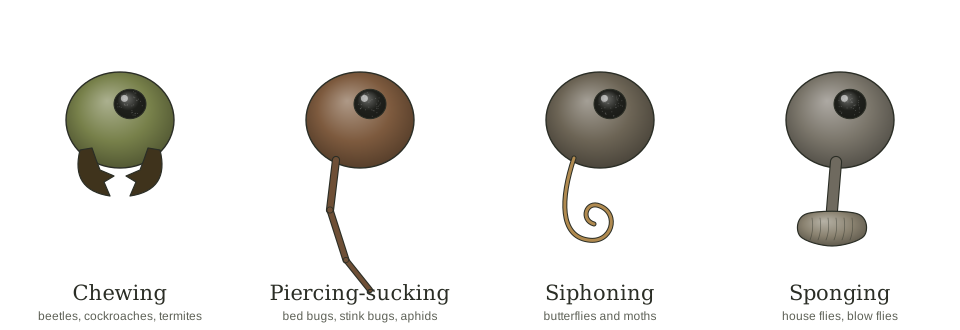
Insects have six main mouthpart types: chewing, chewing-lapping, piercing-sucking, siphoning, sponging and rasping-sucking. Despite how different a beetle’s jaws, a mosquito’s needle and a butterfly’s coiled tongue look, all of them are modified from the same set of parts.
Knowing the type tells you a lot. It tells you what the insect eats, whether it can bite, and what its damage looks like on a leaf, a sweater or your skin. For where the mouthparts sit on the head and how they relate to the rest of the body, see our page on external anatomy.
The ancestral chewing plan
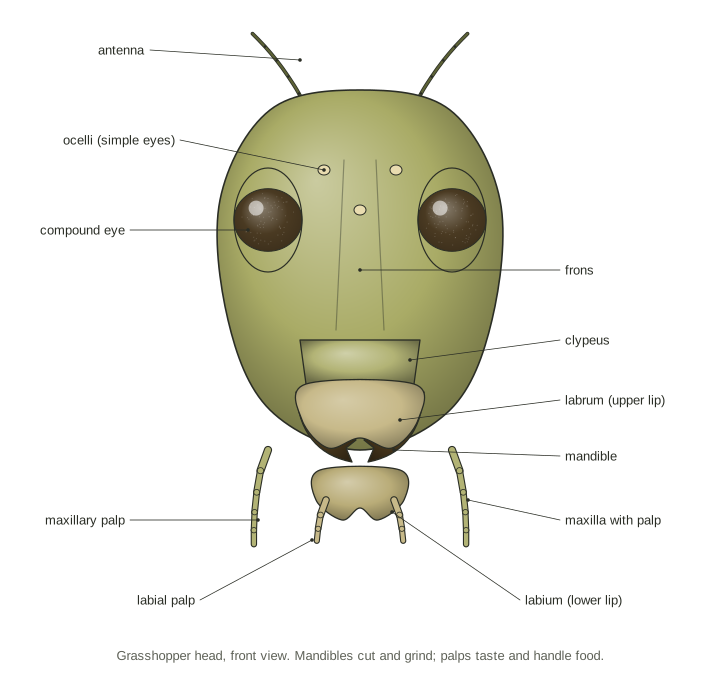
The ancestral insect mouth is the chewing type, still found in grasshoppers, cockroaches, ground beetles and most larvae. It has five main parts, arranged from front to back.
| Part | What it is | What it does |
|---|---|---|
| Labrum | A flap hanging from the front of the head; the “upper lip” | Covers the jaws and holds food in place |
| Mandibles | One pair of heavy, hardened jaws | Bite, cut and grind; they move side to side, not up and down |
| Maxillae | One pair of jointed structures behind the mandibles, each with a sensory palp | Hold and move food; the inner lobes act like a fork and spoon |
| Labium | A single “lower lip,” formed from a fused pair of appendages, with a pair of palps | Closes the mouth from behind and helps handle food |
| Hypopharynx | A tongue-like lobe in the middle of the mouth | Mixes food with saliva; salivary ducts open at its base |
The palps on the maxillae and labium work mainly as touch and taste sensors.
Every other mouthpart type is a remodeling of these same five parts. In some insects a part is stretched into a needle. In others two parts are zipped together into a tube, or a part is lost altogether.
Chewing mouthparts
Who has them: Beetles, grasshoppers and crickets, cockroaches, termites, earwigs, dragonflies, and the larvae of moths, butterflies, sawflies and many beetles.
Chewing insects bite off and grind solid food. The mandibles do the cutting, and their shape varies with diet, from long, sharp jaws in many predators to blunter cutting and grinding edges in many plant feeders.
Weevils are a twist on the same plan. Their head is drawn out into a long snout, with tiny chewing mouthparts at the tip that they use for boring into seeds, grain and plant stems. Caterpillars chew leaves even though the adult moth or butterfly sips liquids. That switch is part of complete metamorphosis.
Chewing-lapping mouthparts
Who has them: Honey bees, bumble bees and many other bees.
Bees keep a pair of ordinary mandibles, but they use them for tasks such as grasping and shaping wax rather than for feeding. For drinking nectar, the maxillae and labium are stretched and folded into a tube-like proboscis. In the center lies a long tongue (the glossa) that laps up liquid, and the surrounding parts form a channel that carries it into the mouth. When not in use, the proboscis folds back under the head.
Piercing-sucking mouthparts
Who has them: True bugs and their relatives (Hemiptera), mosquitoes and other biting flies, fleas, sucking lice and, in a modified form, thrips.
Piercing-sucking insects feed on fluids inside plant or animal tissue. They push slender stylets into the tissue and draw up sap, blood or body fluids through a food canal, while pumping saliva down a separate canal. The details differ between groups.
True bugs (Hemiptera)
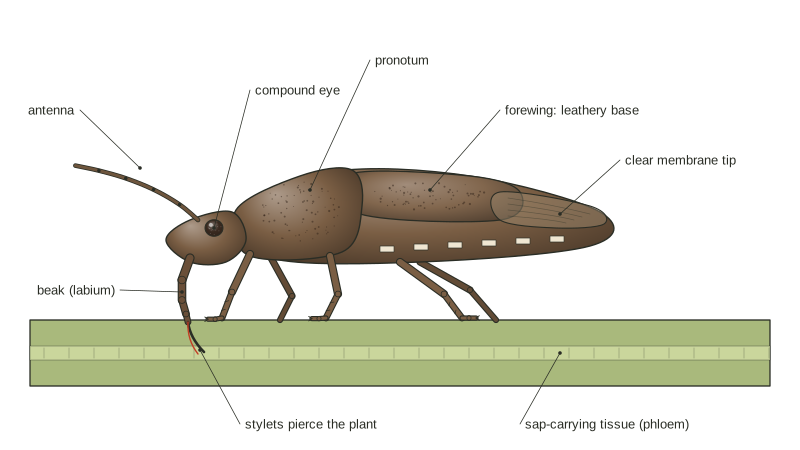
The beak you see on a stink bug, aphid or bed bug is the labium, a jointed sheath of three or four segments. It does not pierce. Inside it lie four stylets:
- Two outer mandibular stylets, the main piercing tools.
- Two inner maxillary stylets, which lock together to form a food canal and a salivary canal.
During feeding, only the stylets enter the tissue, while the labium bends back out of the way. Sap feeders such as aphids, cicadas and leafhoppers usually draw from the plant’s sap-carrying tissue. Predators and some plant-feeding true bugs inject saliva that liquefies the tissue before they suck it up. See Hemiptera for more on how the beak’s position and shape help identify true bugs, hoppers and aphids.
Mosquitoes
A female mosquito’s proboscis contains six stylets: the labrum, a pair of mandibles, a pair of maxillae and the hypopharynx. The labrum and hypopharynx together form the food channel, and saliva flows down a channel through the hypopharynx. The labium again acts as a sheath. It bows back as the stylet bundle slides into the skin.
Only females bite. They need a blood meal to produce eggs. Males feed on nectar and fruit juices, and their mouthparts cannot pierce skin. See mosquitoes for species, breeding sites and prevention.
Fleas
Adult fleas also have piercing-sucking mouthparts and feed on the blood of their hosts, mostly mammals. Unlike mosquitoes, adult fleas live on or near the host for long periods, and both males and females take blood. Flea larvae are different again: they have chewing mouthparts and feed on organic debris in carpet and bedding, including the dried blood in adult flea droppings.
How they differ
| Feature | True bugs | Mosquitoes | Fleas |
|---|---|---|---|
| Stylets | Four (two mandibular, two maxillary) | Six (labrum, two mandibles, two maxillae, hypopharynx) | Piercing-sucking stylets (structure differs) |
| Food | Plant sap, other insects, or blood | Females: blood, needed for eggs. Males: nectar and fruit juices | Blood (adults) |
| Who takes blood | Both sexes, in blood-feeding species such as bed bugs | Females only | Both sexes |
| Young | Nymphs feed the same way as adults | Aquatic larvae, not blood feeders | Larvae chew debris in carpet and bedding |
Siphoning mouthparts
Who has them: Most adult butterflies and moths (Lepidoptera).
The butterfly proboscis is made from the two galeae, lobes of the maxillae, which are zipped together lengthwise to form a tube with a food canal down the middle. At rest it coils like a watch spring under the head. To feed, the insect uncoils it by fluid pressure and sips nectar or other liquids, drawn up by a muscular pump in the head. The mandibles are absent or vestigial in most species, and the most visible remaining parts are the labial palps on either side of the coil. A few primitive moth families still have chewing mouthparts as adults.
Because the adult cannot bite or chew, all the chewing damage linked to moths and butterflies comes from the caterpillars. Some adult moths, such as clothes moths, do not feed at all.
Sponging mouthparts
Who has them: House flies, blow flies, flesh flies and many related flies.
House flies cannot bite. Their proboscis ends in a pair of soft, spongy pads called the labella, which are lined with tiny grooves (pseudotracheae). Liquid food is drawn up those grooves by capillary action into the food channel. To eat something solid, such as sugar, a house fly regurgitates fluid onto it to dissolve it, then mops up the result.
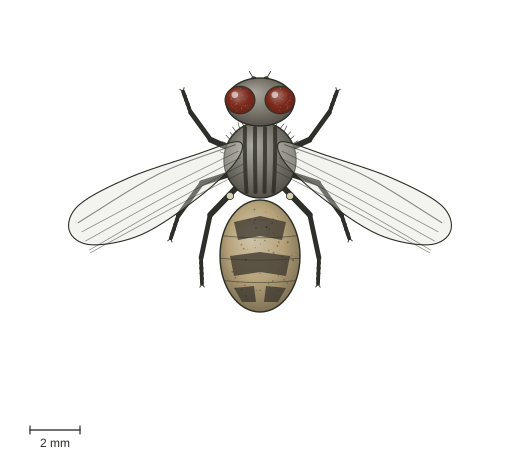
That feeding style is one reason house flies matter around food. House flies have been shown to harbor more than 100 kinds of disease-causing organisms, and they wet food with their own fluids as they feed. See flies for identification and control.
Rasping-sucking mouthparts
Who has them: Thrips (order Thysanoptera).
Thrips are the only insects with lopsided mouthparts. During development the right mandible disappears, leaving only the left one. Their mouth forms a short cone under the head holding three stylets: the single mandible and two maxillary stylets, which together form a food channel. The thrips punctures the outer cells of a leaf, petal or fruit with the mandible, then sucks out the contents.
The result is distinctive damage: stippling, pale flecking or silvery patches on leaves and petals, scabby marks on fruit, and tiny black varnish-like specks of thrips droppings. Thrips are small, generally under 3 mm, and common pest species are less than about 1.3 mm (1/20 inch) long.
Reading the damage
Mouthpart type is one of the fastest ways to narrow down a plant or fabric problem before you ever see the insect.
| What you see | Likely mouthpart type | Common culprits |
|---|---|---|
| Holes in leaves, ragged edges, leaves eaten between the veins | Chewing | Caterpillars, leaf beetles, Japanese beetles, grasshoppers, sawfly larvae |
| Dark pellets (frass) on leaves or below plants | Chewing | Caterpillars |
| Tunnels in wood with sawdust or fine powder | Chewing | Wood-boring beetle larvae |
| Holes in wool, fur or feathers with shed skins or droppings | Chewing | Carpet beetle and clothes moth larvae |
| Fine pale dots (stippling) on leaves | Piercing-sucking or rasping-sucking | Sap-feeding bugs and hoppers; thrips |
| Yellowing, curling, distorted new growth | Piercing-sucking | Aphids, whiteflies |
| Sticky honeydew and black sooty mold | Piercing-sucking | Aphids, soft scales, whiteflies, mealybugs |
| Silvery patches with tiny black specks | Rasping-sucking | Thrips |
| Dimpled, scarred or corky spots on fruit | Piercing-sucking | Stink bugs |
Two quick rules help. Chewing insects remove tissue, so you see something missing. Sucking insects remove fluid, so you see color change, distortion or sticky residue, but the leaf is still all there. Our garden pests section covers the main culprits for both kinds of damage.
Biting and blood-feeding insects
Blood feeders matter to people because they bite, and some can carry disease.
- Mosquitoes. Only females bite. Mosquitoes can spread viruses and parasites, including West Nile virus, dengue and malaria. Learn more on our mosquitoes page.
- Bed bugs. Both sexes and all nymph stages feed on blood, usually at night while people sleep. Bites can be itchy and disturb sleep, but the CDC says bed bugs are not known to spread disease. See bed bugs.
- Fleas. Fleas prefer animals but will bite people. In the US, some flea species can spread plague, murine typhus and other infections, and cat fleas can carry the agent of cat scratch disease.
- Kissing bugs. These blood-feeding true bugs can carry the parasite that causes Chagas disease, though infestations in US homes are rare. Our Hemiptera page summarizes the CDC’s guidance.
At the other end of the scale, house flies, butterflies and moths have no piercing parts and cannot bite at all.
If a bite causes a severe or spreading reaction, swelling of the face or throat, or signs of infection, see a doctor.
References
- Mouthparts. NC State University, General Entomology.
- Insect Mouthparts (lecture notes). North Dakota State University.
- Order Thysanoptera. NC State University, General Entomology.
- Order Siphonaptera. NC State University, General Entomology.
- Thrips: Pest Notes. University of California IPM.
- About Mosquitoes. Centers for Disease Control and Prevention.
- About Fleas. Centers for Disease Control and Prevention.
- About Bed Bugs. Centers for Disease Control and Prevention.
- House Fly. University of Missouri Extension.
See also
- External anatomy of insects
- Hemiptera: true bugs
- Complete metamorphosis
- Mosquitoes
- Bed bugs
- Garden pests
This page was last updated on October 7, 2026. We research our guides from university extension services, government agencies, museums and peer-reviewed literature. Read the editorial policy or report an error.