Wasps: Identifying Yellowjackets, Hornets and Paper Wasps
Most wasps around the home are useful predators. The nest, more than the insect, tells you which ones need attention.
Quick answer
The wasps that nest around US homes are mainly yellowjackets (including the bald-faced hornet), European hornets, paper wasps, mud daubers and cicada killers. Yellowjackets are the most likely to sting, especially near hidden ground or wall nests in late summer. Paper wasps, mud daubers and cicada killers are much less defensive. Leave nests alone when they are out of the way, and get help for nests in walls, near doors or anywhere someone with a sting allergy lives.
The wasps around most US homes are yellowjackets, hornets, paper wasps, mud daubers and cicada killers. Yellowjackets cause the most stings, usually when someone disturbs a hidden nest in the ground or a wall, or swats a forager over food in late summer. Paper wasps sting mainly when their open nest is bumped. Mud daubers and cicada killers are solitary and rarely sting.
Wasps also do real good. Most are predators that remove caterpillars, flies and other insects from gardens and yards. The goal is not to remove every wasp, but to deal with nests that put people at risk.
Wasps, bees and the order Hymenoptera
Wasps, bees and ants all belong to the order Hymenoptera. Only females can sting, because the stinger is a modified egg-laying organ.
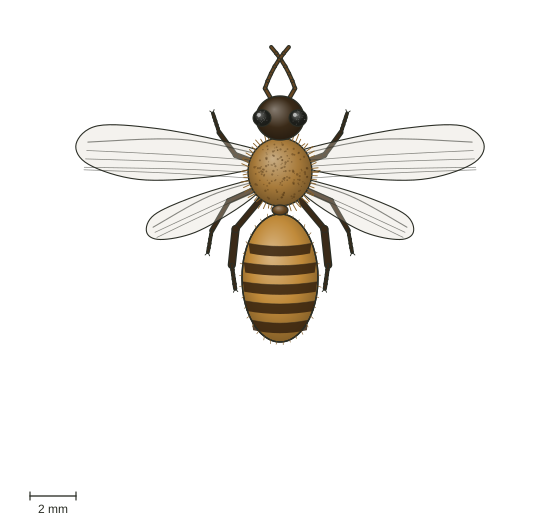
Wasps generally have smooth, shiny bodies with few hairs and a narrow, pinched waist. Most are predators or scavengers. Bees are usually hairier and stockier and collect pollen and nectar.
Social wasps
Social wasps live in annual colonies that start each spring with a single queen. The colony grows through summer and dies off with cold weather. Only fertilized queens survive the winter, sheltering in protected spots such as under bark or in buildings, and they start new nests the next year. Old nests are not reused.
Yellowjackets
Yellowjackets (Vespula and Dolichovespula species) are about 13 to 25 mm (1/2 to 1 inch) long, with jagged bright yellow and black bands and a very narrow waist. University of Kentucky Entomology ranks them among the most dangerous stinging insects in the US, since their nests are often hidden and they defend them.
Nests: Most yellowjackets build enclosed paper nests in cavities:
- In the ground, often in old rodent burrows, under rocks, garden timbers or splash blocks, and at the base of shrubs. The only sign may be a steady stream of wasps flying in and out of a hole.
- In walls and structures, including wall voids, attics, crawl spaces, behind siding and in stone walls. University of California IPM notes that workers enlarging a nest inside a house can create a damp patch that becomes a hole in the wall or ceiling.
- In the open, hanging from eaves or branches, for a few aerial species such as the bald-faced hornet.
Depending on species and region, a colony can reach several hundred to many thousands of wasps by late summer.
Late-summer behavior: By late summer and fall, colonies are at peak size, and many workers forage for sugar and protein. They scavenge at picnics, trash cans, outdoor pet food, ripe fruit and hummingbird feeders, and can crawl into open soda cans. University of Kentucky notes that foragers away from the nest seldom sting unless trapped or swatted; most stings at picnics happen when a wasp is slapped or pressed against skin. Near the nest it is a different story. Yellowjackets defend their nests, and many stings happen when someone mows, trims or digs over a hidden nest without knowing it is there.
Bald-faced hornet
Despite its name, the bald-faced hornet (Dolichovespula maculata) is not a true hornet. Penn State Extension describes it as an aerial yellowjacket. It is black with ivory-white markings on the face, thorax and abdomen, and about 13 to 20 mm (1/2 to 3/4 inch) long.
It builds the large, gray, football-shaped paper nests seen hanging in trees, shrubs and sometimes under eaves. A nest has a single entrance, usually near the bottom, and Penn State reports nests up to about 60 cm (2 feet) tall. Colonies of roughly 100 to 400 workers defend the nest vigorously when it is disturbed. Bald-faced hornets also prey on other insects, including other yellowjackets.
European hornet
The European hornet (Vespa crabro) is a true hornet. It is large, up to about 25 mm (1 inch) for workers and about 35 mm (1 3/8 inches) for queens. The head and thorax are reddish brown and the abdomen is mostly yellow with brown markings, so it looks like an oversized yellowjacket.
It nests in protected cavities such as hollow trees, barns, sheds, attics and wall voids. The tan paper nest is usually tucked inside the cavity, so you see hornets coming and going rather than the nest itself. Unusually, European hornets fly at night and are attracted to lit windows and porch lights. In late summer and fall they sometimes strip bark from lilac and other shrubs to feed on sap. Penn State Extension describes the sting as about as painful as a honey bee’s; they can sting more than once.
Paper wasps
Paper wasps (Polistes species) are long-legged, slender wasps, usually reddish brown to black with variable striping and a very thin waist. The European paper wasp is black and yellow and easily mistaken for a yellowjacket.
Nests: Paper wasps build the familiar open, umbrella-shaped nests of gray paper cells hanging from a single stalk under eaves, porch ceilings, deck railings, shutters, grills, mailboxes and light fixtures. The cells are open and visible from below. Nests are usually no bigger than an outstretched hand and hold about 15 to 200 wasps.
Behavior: Paper wasps are much less defensive than yellowjackets and rarely sting unless their nest is touched or bumped. They are useful predators of caterpillars. In fall, mated queens may move into attics and wall voids for the winter and appear indoors on warm days.
Solitary wasps
Solitary wasps do not build colonies. Each female builds her own nest and stocks it with paralyzed prey for her young. With no colony to defend, they very rarely sting people.
Mud daubers
Mud daubers are slender, thread-waisted wasps, either black and yellow or metallic blue-black. They build hard mud nests on walls and ceilings in porches, garages, sheds and attics.
University of California IPM notes that mud daubers do not defend their nests and rarely sting, and that nests can be removed safely in winter without spraying.
Cicada killers
Cicada killers are very large wasps, roughly 30 to 50 mm (1 1/4 to 2 inches) long, mostly black with pale yellow markings and reddish wings. They look alarming, but University of Maryland Extension notes they are not aggressive and usually do not bother people. Males are territorial around nesting areas but cannot sting. Females use their sting to paralyze cicadas, which they carry back to feed their young.
Females dig burrows in bare, sunny, well-drained soil, and many may nest close together, leaving holes in a lawn or garden bed. Nesting is temporary. University of Maryland Extension suggests overseeding thin turf, mulching bare soil, and running a sprinkler over the area to discourage them.
Nest identification table
| Wasp | Nest look | Typical location | Defensiveness |
|---|---|---|---|
| Yellowjacket (ground) | Hidden paper nest; only an entry hole visible | Old rodent burrows, under rocks, timbers, shrubs | High near nest |
| Yellowjacket (wall) | Hidden; wasps entering a gap | Wall voids, attics, behind siding, crawl spaces | High near nest |
| Bald-faced hornet | Large gray paper football, single bottom entrance | Trees, shrubs, eaves | High near nest |
| European hornet | Tan paper nest inside a cavity | Hollow trees, sheds, attics, wall voids | Defensive |
| Paper wasp | Open umbrella of gray cells on a stalk | Eaves, porch ceilings, railings, shutters, grills | Low to moderate |
| Mud dauber | Hard mud tubes or lumps | Walls, ceilings, garages, sheds | Very low |
| Cicada killer | Holes in bare soil | Sunny lawns and garden beds | Very low |
Stings and allergic reactions
Most stings cause sharp pain followed by redness, swelling and itching at the site. University of California IPM suggests washing the area, using a cold compress, and an antihistamine for itching and swelling. Avoid scratching. Honey bees usually leave a barbed stinger in the skin, which should be scraped out quickly. Hornets and other wasps keep their stingers and can sting more than once.
Some people are allergic to venom. University of Kentucky Entomology estimates that about 1 percent of the US population is hypersensitive to insect venom. For them, a single sting can cause anaphylaxis, a severe allergic reaction that can be fatal.
Get emergency medical help right away (call 911) if, after a sting, someone has signs like these:
- Hives or widespread itching
- Swelling of the tongue or throat
- Difficulty breathing or swallowing
- Dizziness, fainting or loss of consciousness
- Stomach cramps, nausea or diarrhea along with other symptoms
The American Academy of Allergy, Asthma & Immunology (AAAAI) describes anaphylaxis as a medical emergency that can bring a rapid drop in blood pressure, shock and loss of consciousness. University of California IPM notes that reactions can start immediately or up to about 30 minutes after a sting. People with known sting allergies should carry prescribed epinephrine and use it as directed, but epinephrine does not replace emergency care: go to an emergency room even after using it. Stings in the mouth or throat, where swelling can block the airway, and large numbers of stings also need urgent medical attention. After any severe reaction, ask about seeing an allergist, who can test for venom allergy and discuss treatments that lower future risk.
Reducing stings around the home
- Keep food and drinks covered outdoors, and check open cans and cups before drinking.
- Use trash cans with tight lids, and clean up fallen fruit and spilled pet food.
- Avoid heavily scented products when eating or working outdoors.
- Watch for wasps flying in and out of one spot before mowing, trimming or digging.
- Wear long sleeves and long pants when working where a nest may be disturbed.
- Do not swat at foraging wasps; move away calmly.
- Do not count on insect repellents, which do not reliably deter stinging insects.
When to leave a nest alone
Many nests can be left in place. Consider leaving a nest alone when:
- It is high in a tree, at the edge of a property, or otherwise away from doors, paths and play areas.
- It belongs to paper wasps or mud daubers and is not in a high-traffic spot.
- It is late in the season. In areas with cold winters, the colony will die off with cold weather, and the nest will not be reused.
- It is a cicada killer nesting area, which is active only temporarily.
When to have a nest removed
Remove or treat nests that are close to where people walk, sit, play or work, or anywhere someone with a known sting allergy lives. Professional help is the safer choice for:
- Yellowjacket nests in the ground near lawns and paths
- Any nest inside a wall, ceiling, attic or crawl space
- Bald-faced hornet nests near entrances or low in shrubs
- Nests that require a ladder, are high overhead or are hard to reach
- Large or very active nests late in the season
Extension specialists warn that treating yellowjacket and hornet nests is risky. University of California IPM notes that wasps may still sting after dark, sprays may not reach a nest set back from the entrance, and agitated wasps can remain active the next day. University of Kentucky calls ground and wall nests a danger zone and recommends a professional when access is difficult or a ladder is needed. Our guide on when to call a professional explains how to choose help.
References
- Controlling Wasps, Hornets and Yellowjackets (ENTFACT-620). University of Kentucky Entomology.
- Yellowjackets and Other Social Wasps. University of California Statewide IPM Program.
- Non-Honey Bee Stinging Insects in North Carolina. NC State Extension.
- Baldfaced Hornet. Penn State Extension.
- European Hornet. Penn State Extension.
- Cicada Killer Wasps. University of Maryland Extension.
- Bee and Wasp Stings. University of California Statewide IPM Program.
- Stinging Insect Allergy. American Academy of Allergy, Asthma & Immunology.
See also
This page was last updated on October 7, 2026. We research our guides from university extension services, government agencies, museums and peer-reviewed literature. Read the editorial policy or report an error.