Hymenoptera: Ants, Bees, Wasps and Sawflies
One of the largest insect orders, home to pollinators, parasitoids, social colonies and a few stinging pests.
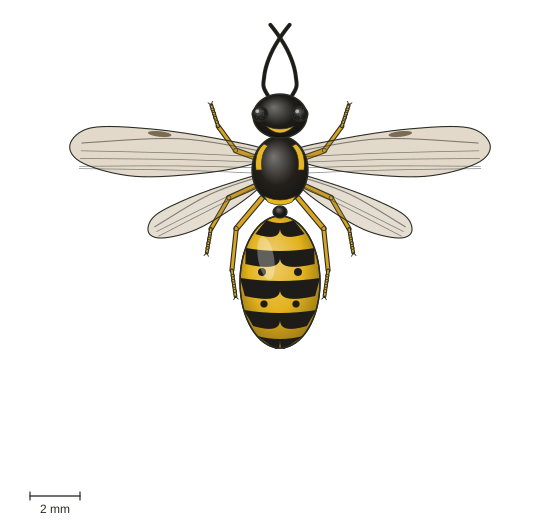
Hymenoptera is the order of ants, bees, wasps and sawflies. You can usually spot a member by two pairs of clear, membranous wings that lock together in flight, chewing mouthparts, and, in ants, bees and wasps, a pinched “wasp waist.” Females of many groups carry a stinger, which evolved from the egg-laying tube.
The order is enormous. BugGuide counts about 18,000 species in North America north of Mexico and more than 153,000 described worldwide, and some specialists estimate the true total at a million or more. A large share are small parasitic wasps that people rarely notice. A handful, such as yellowjackets and a few ants, become household pests. Many more pollinate crops and wild plants or keep other insects in check.
How to spot Hymenoptera
Two pairs of hooked-together wings
The name means “membrane wings.” Most adults have four clear wings, with the front pair larger than the hind pair. Tiny hooks called hamuli on the hind wing couple it to the forewing, so the two wings on each side work as one. In flight a bee or wasp can look two-winged, which is one reason they get mixed up with flies. Flies have only one pair of wings; see the Diptera page.
Not every member has wings. Ant workers are wingless, and only the reproductive males and young queens grow wings for their mating flights.
The narrow waist
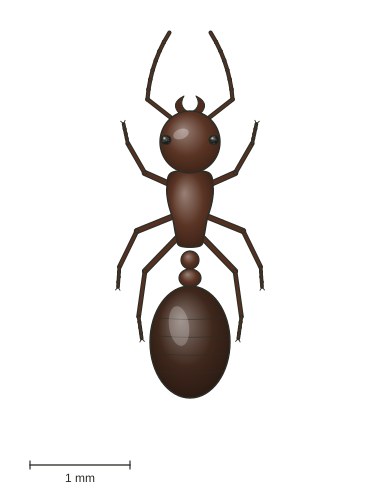
In ants, bees and wasps, the body is sharply pinched near the front of the abdomen. This “wasp waist” lets the abdomen bend and swing, which matters for egg-laying and stinging. In ants, the waist carries one or two small bumps (nodes) that help with identification. Sawflies and horntails lack the waist: their thorax and abdomen join broadly.
Size
Members range from 0.2 mm to about 115 mm long, though most fall between 2 and 30 mm (about 1/16 to 1 1/4 inches). The smallest parasitic wasps are barely visible without magnification.
Chewing mouthparts and long antennae
Adults have chewing mandibles, sometimes with a tongue-like structure for lapping fluids such as nectar. Antennae are usually long and have 10 or more segments, often 12 in females and 13 in males. Ant antennae are bent at a sharp elbow.
Stingers as modified ovipositors
Female insects of many orders lay eggs through a tube called the ovipositor. In the stinging Hymenoptera, the ovipositor has become a stinger connected to venom glands, used to paralyze prey and defend the nest. That has a simple consequence: only females can sting. Males of bees, wasps and ants are harmless.
A honey bee’s stinger is barbed and usually stays in the skin, where venom keeps pumping for close to a minute, so scrape or pull it out quickly. Yellowjackets have smooth stingers and can sting repeatedly.
Complete metamorphosis
Hymenoptera develop through egg, larva, pupa and adult, the pattern described on the complete metamorphosis page. Sawfly larvae look like caterpillars and walk on fleshy prolegs. Most other larvae are pale, legless grubs that depend on adults or a host for food.
Haplodiploidy: how sex is set
In most Hymenoptera, males usually develop from unfertilized eggs and females from fertilized ones. This system is called haplodiploidy: an unfertilized egg carries one set of chromosomes (haploid), and a fertilized egg carries two (diploid).
In a social colony, that means the queen’s fertilized eggs become the female workers and future queens, while males come from unfertilized eggs. It is also why every worker ant, and every stinging worker bee or wasp, is female.
Social behavior and castes
Social life with a division of labor, called eusociality, is best developed in the stinging Hymenoptera. All ants, some bees and some wasps live in colonies with distinct castes.
- Queens lay the eggs. In many species a single newly mated queen starts a colony alone and raises the first workers herself.
- Workers are sterile or nearly sterile females. They gather food, feed larvae, build and defend the nest, and make up most of the colony.
- Males are few and short-lived. Their role is to mate with new queens.
Colony life cycles differ. Most yellowjacket colonies last one season: a mated queen overwinters, starts a nest alone in spring, and the colony grows through summer before declining. Ant colonies can last for years, and after a few years they begin producing winged males and queens. A few species, such as the Argentine ant, link many nests and queens into huge supercolonies.
Many bees and wasps are solitary. A female builds her own nest and stocks it with food for her young; most US bee species nest this way in the ground. Solitary wasps such as mud daubers do not defend their nests and rarely sting.
Suborders: Symphyta and Apocrita
Classifications split Hymenoptera into two traditional groups. The first is now known to be an artificial grouping, but the names remain useful.
Symphyta: sawflies, horntails and wood wasps
Symphyta lack the narrow waist. Females of many species use a saw-edged ovipositor to cut slits in leaves, needles or stems for their eggs, which gives sawflies their name. The larvae feed on plants. Garden sawfly larvae such as roseslugs and pine sawflies are easily mistaken for caterpillars, but they have six or more pairs of prolegs, a single small eye on each side of the head, and no hooks on their prolegs. Adult sawflies cannot sting. The caterpillar identification guide explains how to tell the larvae apart.
Apocrita: wasp-waisted Hymenoptera
Apocrita includes everything with the narrow waist. It is often divided into two informal groups.
- Parasitica (parasitic wasps): a huge assortment of mostly small wasps whose larvae develop as parasitoids of other insects. The Ichneumonoidea, which includes ichneumon and braconid wasps, is the most diverse group.
- Aculeata (stinging Hymenoptera): wasps, ants and bees, in which the ovipositor works as a stinger.
Major groups at a glance
| Group | Examples | How to spot them | Notes |
|---|---|---|---|
| Sawflies (several families) | Roseslug, pine sawflies, columbine sawfly | Broad waist; larvae look like caterpillars | Larvae eat leaves; adults do not sting |
| Horntails and wood wasps | Horntails | Broad waist | Larvae develop in wood |
| Ichneumon and braconid wasps | Ichneumons, Cotesia wasps | Narrow waist; females with a visible ovipositor in many species | Parasitoids of caterpillars and other insects |
| Tiny parasitic wasps | Aphid parasitoids | Very small; rarely noticed | Leave aphid “mummies” behind |
| Social wasps (Vespidae) | Yellowjackets, hornets, paper wasps | Smooth body, narrow waist, often yellow or red markings | Paper nests; yellowjackets defend nests strongly |
| Solitary hunting wasps | Mud daubers, spider wasps | Slender, narrow waist | Provision nests with prey; rarely sting people |
| Ants (Formicidae) | Carpenter, odorous house, pavement and fire ants | Elbowed antennae; one or two nodes on the waist | All species are social |
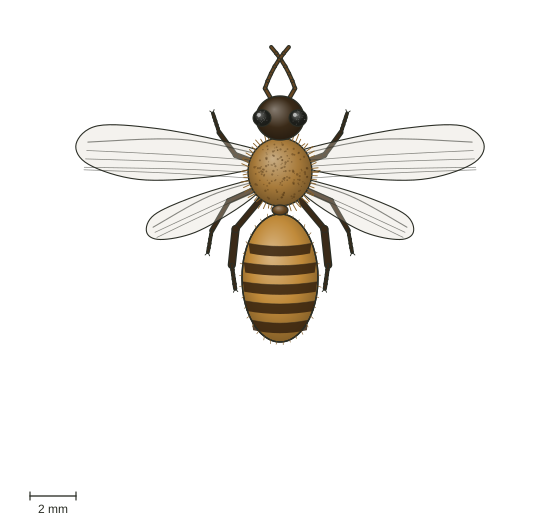
| Bees (Apoidea) | Honey bee, bumble bees, mining and sweat bees | Usually hairy body | Feed young on pollen and nectar |
Beneficial roles
Pollination
Bees are the main animal pollinators of many crops and wild plants. USDA counts more than 3,600 bee species in the United States, and about 70 percent of them nest in the ground. Managed honey bees, brought from Europe by colonists in the 1500s and 1600s, are not native but are easy to move and manage at scale. The USDA Agricultural Research Service estimates that managed honey bee colonies add at least $18 billion a year to the value of US crops. California’s almond orchards alone use about three-quarters of the nation’s managed colonies during bloom.
Natural pest control
Parasitic wasps are major natural enemies of crop and garden pests. A tomato hornworm studded with small white cocoons has been parasitized by a braconid wasp, and an aphid that has turned into a swollen, tan “mummy” holds a developing wasp. Social wasps kill large numbers of plant-feeding insects and flies to feed their larvae. Ants prey on fleas, caterpillars, termites and other insects, though some also protect aphids and scales for their sugary honeydew.
Scavenging
Ants clean up dead insects and decomposing animal tissue, recycling them back into the soil food web.
Household relevance
Only a small share of Hymenoptera cause trouble indoors, but they are some of the most common household calls.
- Ants forage in kitchens for sweets, grease and water. Common household species include odorous house ants, pavement ants, Argentine ants and pharaoh ants. Carpenter ants hollow out moist or damaged wood for nests, though they do not eat it. Fire ants deliver painful stings outdoors. See ants in the house for identification and control.
- Yellowjackets and paper wasps are the stinging insects most often found around homes. Yellowjackets are 13 to 25 mm (1/2 to 1 inch) long, black with jagged yellow bands, and nest in the ground, wall voids or enclosed paper nests. Paper wasps are slender and long-legged, and hang open, umbrella-shaped nests under eaves. Yellowjackets grow more defensive as colonies grow, and by late summer and fall the workers scavenge for sugary foods at picnics and trash cans. See wasps and yellowjackets.
- Honey bees are valued pollinators, but a nest near a doorway is still a stinging risk. Africanized honey bees look the same as other honey bees and have the same venom, but they are less predictable, guard a larger area around the nest, and respond in greater numbers.
Two identification questions come up again and again. To separate the two most-confused stinging insects, see bee vs wasp. And when winged insects swarm indoors in spring, check whether they are ants or termites: ants have elbowed antennae, a pinched waist and front wings longer than the hind wings, while termites have straight antennae, a thick waist and four wings of equal length. The termite vs flying ant comparison covers the details.
References
- Order Hymenoptera. BugGuide, Iowa State University.
- Hymenoptera fact file. Amateur Entomologists' Society.
- Yellowjackets and Other Social Wasps (Pest Notes). University of California IPM.
- Ants (Pest Notes). University of California IPM.
- Bee and Wasp Stings (Pest Notes). University of California IPM.
- Honey Bees and Colony Collapse Disorder. USDA Agricultural Research Service.
- Pollinators. USDA People's Garden.
- Sawflies. University of Wisconsin-Madison Extension.
- Hymenoptera (ENT 425 Compendium). NC State University.
See also
This page was last updated on October 7, 2026. We research our guides from university extension services, government agencies, museums and peer-reviewed literature. Read the editorial policy or report an error.