Water Bug vs Cockroach: How to Tell Which One You Found
One name, two very different insects. Where you found it settles most cases.
Quick answer
A ‘water bug’ found in a basement, bathroom or drain is almost always a cockroach, usually the Oriental cockroach, which is shiny black and about 25 mm (1 inch) long. A true water bug is a giant water bug: an aquatic insect 50 to 100 mm (2 to 4 inches) long that lives in ponds and flies to outdoor lights. It does not infest houses.
“Water bug” is used for two unrelated insects. In everyday speech it means a large, dark cockroach found somewhere damp. Purdue University lists “water bug” as a nickname for the Oriental cockroach. To an entomologist, a water bug is an aquatic true bug, and the one people notice is the giant water bug, which the University of Maine calls the largest true bug in the US and Canada.
The two are easy to separate once you know what to check.
Quick comparison
| “Water bug” cockroach | Giant water bug | |
|---|---|---|
| What it is | Oriental or American cockroach | Aquatic true bug |
| Length | 25 to 50 mm (1 to 2 inches) | 50 to 100 mm (2 to 4 inches) |
| Antennae | Long and thread-like, easy to see | Not visible from above |
| Found | Basements, drains, bathrooms, garages | Ponds and streams; under outdoor lights at night |
| Indoors | Common | Accidental |
| Infests houses | Yes | No |
The first row to check is location. An insect in a floor drain, under a sink or in a damp basement is a cockroach. An enormous flat brown insect on the pavement under a parking lot light is a giant water bug.
The cockroaches called water bugs
Oriental cockroach
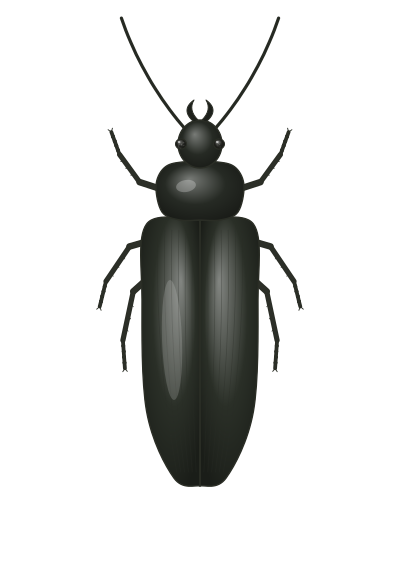
This is the usual “water bug.” It is about 25 to 32 mm (1 to 1 1/4 inches) long and shiny black or very dark brown. Neither sex flies. The male’s wings stop short of the tip of the body, and the female has only small wing stubs, which gives her a broad, beetle-like look. Purdue notes it is also called the “black beetle.”
It likes cool, dark, damp places: basements, crawl spaces, garages, water meter boxes and drains, and outdoors around woodpiles, ivy and ground cover. It comes into buildings at night, mostly at ground level, and can climb up through damaged drain pipes and end up trapped in a sink or tub.
American cockroach
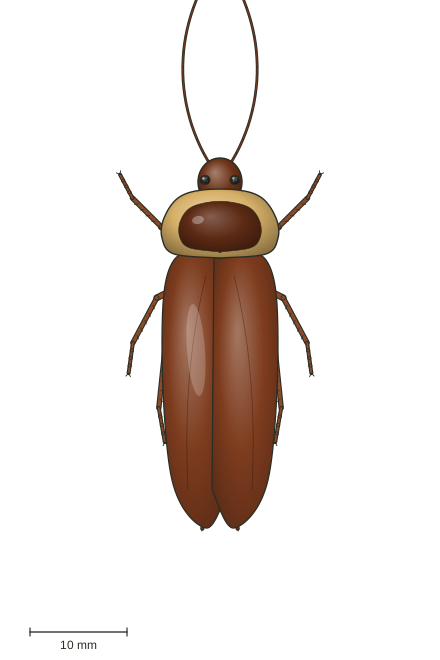
Larger and reddish brown, about 38 to 50 mm (1 1/2 to 2 inches) long, with a pale margin on the shield behind the head. It lives in sewers, storm drains and steam tunnels and enters ground floors through damaged pipes and dry drain traps. In the Southeast the same insect is often called a palmetto bug.
Both species are covered on our cockroaches page.
The true water bug
Giant water bugs live in fresh water. Adults are 50 to 100 mm (2 to 4 inches) long, far bigger than any house cockroach. They are true bugs, in the order Hemiptera, with piercing mouthparts in place of the chewing jaws a cockroach has.
Adults fly, and they are drawn to lights at night. That is how people meet them: on a porch, a parking lot or a ball field, well away from water. The University of Maine lists their other common names as toe-biters and electric-light bugs, along with “water roaches,” which keeps the confusion going.
They can deliver a painful bite, so do not pick one up bare-handed. Scoop it into a container with a piece of card and let it go near water. They do not breed in houses, feed on household food or need treating.
How to tell them apart up close
- Antennae. A cockroach has two long, whip-like antennae that are always moving. A giant water bug shows none from above.
- Legs. Cockroach legs are long, spiny and built for running. A giant water bug’s body is broad and flat, built for swimming.
- Speed. A cockroach runs for cover the moment a light comes on. A giant water bug out of water is slow and clumsy.
- Size. Anything over 50 mm (2 inches) is not a house cockroach.
What a water bug in the house means
If it is a cockroach, one or two a season in a basement or bathroom usually means individuals are getting in from outside or from the drains. Regular sightings, egg cases or several sizes together point to a population living close by.
Start with moisture and entry points:
- Repair leaks and reduce damp in basements and crawl spaces.
- Keep water in floor drain traps and repair damaged drain lines.
- Fit door sweeps and seal gaps where pipes and wires enter.
- Pull woodpiles, ivy and heavy ground cover back from the foundation.
- Place sticky traps along basement walls and near drains to see how many there are and where they travel.
The University of California recommends baits as the main control for these outdoor-living roaches, placed where they shelter, and notes that sprays and foggers give only short-term results. Read and follow the label on any product. Full steps are in cockroach control.
If it is a giant water bug, nothing more is needed. Turning off or shielding bright outdoor lights makes them less likely to land at your door.
Other damp-area insects
Not every dark insect near water is either of these. Bugs in the bathroom covers silverfish, drain flies and the others that turn up around sinks and tubs, and the identification finder narrows things down by size, shape and place.
References
- Giant Water Bug. University of Maine Cooperative Extension.
- Cockroaches (E-23). Purdue University Extension Entomology.
- Pest Notes: Cockroaches. University of California Statewide IPM Program.
See also
- Cockroaches: identification
- Palmetto bugs
- Bugs in the bathroom
- Cockroach control
- Hemiptera: true bugs
This page was last updated on November 10, 2026. We research our guides from university extension services, government agencies, museums and peer-reviewed literature. Read the editorial policy or report an error.