Termite Mud Tubes: Types, Where to Look and How to Test Them
Pencil-width tunnels of dried mud on a foundation are the most common sign of subterranean termites. Here is how to read them.
Quick answer
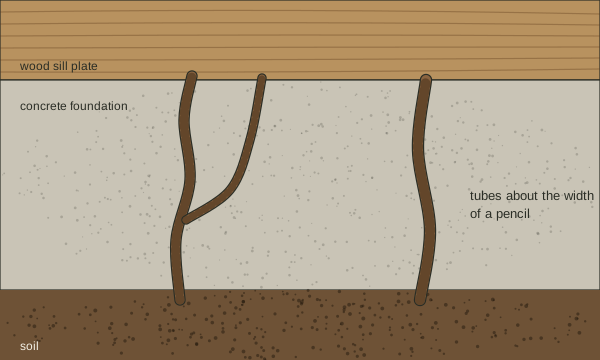
Termite mud tubes are earth-colored tunnels, usually about as wide as a pencil, that subterranean termites build from soil, saliva and bits of wood to travel between the ground and the wood they eat. A tube on a foundation, pier or sill plate is strong evidence of termites. To test one, break out a 1-inch section and check back in a few days: live termites or a repaired gap means the infestation is active.
A termite mud tube is a covered walkway. Subterranean termites live in the soil and dry out fast in open air, so they build tunnels of soil and saliva, with bits of wood or drywall mixed in, to reach the wood above ground. The University of Kentucky describes the tubes as about the thickness of a pencil, sometimes thicker, running over foundation walls, piers, sill plates and floor joists.
A tube on the structure is one of the few termite signs a homeowner can find without tools.
What mud tubes look like
- Color. Earth-colored, matching the local soil.
- Width. Around pencil width, sometimes thicker.
- Texture. Rough and grainy, like dried mud dabbed on in a line.
- Path. They start at the soil or a crack in the slab and head for wood. They follow corners, cracks, pipes and the back of trim, and they branch.
The four types of tube
The University of California lists four kinds. Knowing them helps you judge what you are looking at.
| Type | Where it runs | What it tells you |
|---|---|---|
| Working tube | From soil up to wood | An established route between colony and food |
| Exploratory tube | Up from soil, ending without reaching wood | Termites are foraging here |
| Drop tube | From wood back down toward the soil | Termites are already in the wood above |
| Swarm tube | Short, built at an exit point | The colony is preparing to release swarmers |
Drop tubes are the ones people mistake for something else. They hang free from a joist or subfloor in a crawl space like a thin stalactite.
Formosan termites build a wider version of a swarm tube. Mississippi State University Extension calls these swarm castles: patches about 3 inches wide that stick out about 1.5 inches from a wall or ceiling in late spring.
Where to look
Mississippi State and Penn State list these places:
- Inside and outside faces of foundation walls
- Support piers and posts in crawl spaces and basements
- Sill plates, mudsills and floor joists
- Along plumbing and other pipes that pass through the slab or foundation
- Door and window trim
- Expansion joints and cracks in concrete slabs and garage floors
Tubes are often hidden. Check behind stored boxes, under insulation at the top of the foundation wall, behind shrubs and inside the corners of the crawl space. A flashlight held flat against the wall makes them stand out.
Tubes high on interior walls, on ceilings, or on soffits and fascia often indicate Formosan termites. Tubes can also run over or through foam board insulation. Termites tunnel through the foam without eating it.
How to test whether a tube is active
Both Mississippi State and the University of Kentucky describe the same check.
- Photograph the tube first, with something for scale.
- Break out a section about 1 inch long near the middle.
- Look inside straight away. Small, creamy white workers in the gap mean the tube is in use.
- If it is empty, mark the spot and check again over the next few days.
A rebuilt gap means termites are still using the route. Either result, live termites or a repair, means an active infestation.
An empty tube that stays broken is not an all-clear. Termites abandon sections of tube while they forage elsewhere, and the tubes you can see may not be the only way in.
Small mud spots on walls and ceilings
Mud does not always form a tube. Mississippi State describes BB-sized dabs of dried mud on drywall or ceilings that cover a pinhole. Scrape one away, mark it and watch for a few days. If the hole is plugged again, termites are behind it.
Sunken, wandering lines in paint or wallpaper are a related sign. Termites may be feeding on the paper face of the drywall underneath.
What else leaves mud on a wall
Mud dauber wasps also build with mud. Their nests are short, closed tubes or lumps stuck to a wall or ceiling, with no connection to the soil. See wasps and hornets.
A termite tube is hollow, and it leads from the ground or a crack toward wood.
Do old tubes mean old termites?
Not reliably. A dry, brittle tube may have been empty for years, or it may be a route termites stopped using last month. Mississippi State recommends scraping away tubes that are confirmed inactive after an inspection or treatment, so nobody mistakes them for new activity later.
If the house has been treated before, find the paperwork. A current service agreement usually covers retreatment.
What to do if you find mud tubes
Mud tubes are a reason to schedule an inspection, and there is no need to panic. Termites damage wood slowly, and the University of Kentucky notes that a few days or weeks spent choosing a company makes little difference.
- Test one tube as described above and take photos.
- Leave the other tubes in place.
- Avoid spraying the area with household insecticide. It kills the few termites it touches and leaves the colony in the soil untouched.
- Arrange a termite inspection with a licensed company, and consider a second opinion.
While you wait, fix the conditions that made the route easy. The University of Kentucky advises keeping wood siding and frames at least 6 inches above the soil, moving firewood and lumber away from the foundation, and directing water away from the house. Treatment itself is covered in termite treatment methods.
References
- Termite Control: Answers for Homeowners (ENTFACT-604). University of Kentucky Entomology.
- Signs of Termite Infestation. Mississippi State University Extension.
- Subterranean and Other Termites: Pest Notes. University of California Statewide IPM Program.
- Eastern Subterranean Termites. Penn State Extension.
- Protecting Your Home Against Termites (ENTFACT-605). University of Kentucky Entomology.
See also
- Signs of termites
- Termite droppings
- What termites look like
- Termite inspection
- Termite treatment methods
This page was last updated on November 10, 2026. We research our guides from university extension services, government agencies, museums and peer-reviewed literature. Read the editorial policy or report an error.