Termite Droppings (Frass): What They Look Like and What They Mean
Small piles of dry, gritty pellets under wood are the calling card of drywood termites. Here is how to confirm them.
Quick answer
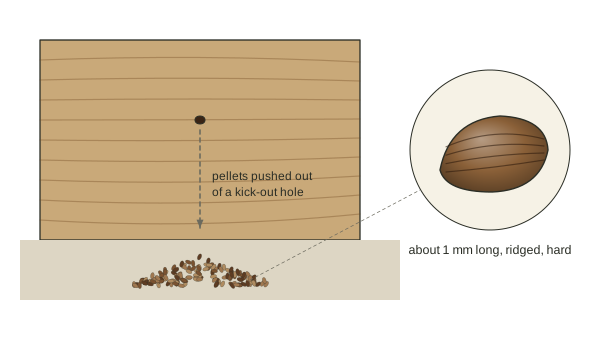
Termite droppings, called frass, are tiny, hard, dry pellets with six flat sides running lengthwise. They are uniform in size and collect in small piles below infested wood. Only drywood termites leave them in the open. Subterranean termites, the most common kind, use their droppings to build mud tubes, so you will not find loose pellets from them.
Termite droppings are small, dry, hard pellets that pile up beneath the wood the termites are living in. Entomologists call them frass. Under a magnifier each pellet has six flat sides with ridges running along its length, a shape the University of California calls diagnostic for drywood termites. Nothing else in a house produces it.
If you have found a gritty little pile on a windowsill, floor or countertop that comes back after you sweep it, this page will help you confirm what it is.
What drywood termite pellets look like
- Shape. Six-sided, with clear lengthwise ridges. You need a hand lens or a phone camera at full zoom to see the sides.
- Size. Tiny and uniform. Every pellet in the pile is close to the same size and shape, which is what Mississippi State University Extension points to first.
- Texture. Dry and hard. They feel like sand or grit between your fingers and do not smear.
- Color. It follows the wood the termites are eating, so one pile can hold light and dark pellets.
To the naked eye a pile looks like coarse pepper, sand or coffee grounds.
Where the piles form
Drywood termites live entirely inside dry wood. They keep their galleries clean by pushing pellets out through small openings called kick-out holes, which the University of California measures at under 2 mm across. The pellets fall and collect directly below.
Common places to find a pile:
- Windowsills and the floor under window and door frames
- Below exposed beams, rafters and attic framing
- Under or inside wooden furniture
- Along baseboards and hardwood floors
- On countertops and shelves beneath cabinets
Look straight up from the pile. The kick-out hole is usually right above it, and it marks the infested board.
Why subterranean termites leave no droppings
This catches people out. Subterranean termites cause most termite damage in the US, and they do not leave pellets. Their droppings are soft, and the colony uses them, along with soil and saliva, as building material for shelter tubes and gallery linings.
So the evidence differs by type:
| Termite | Droppings you can see | Main evidence instead |
|---|---|---|
| Drywood | Six-sided pellets in piles | Kick-out holes, shed wings |
| Dampwood | Football-shaped pellets, rounded ends, no ridges | Wet or decaying wood |
| Subterranean and Formosan | None | Mud tubes, soil-lined galleries |
A house with no pellets can still have termites. If you live outside drywood territory, the signs of termites guide covers what to look for.
Termite droppings vs sawdust and powder
Three wood-infesting insects push debris out of wood. The texture tells you which one.
| Debris | Look and feel | Source |
|---|---|---|
| Hard pellets, all one size, six-sided | Gritty, like sand | Drywood termites |
| Coarse shavings mixed with soil and insect parts | Fibrous, like pencil-sharpener waste | Carpenter ants |
| Very fine powder | Like flour or talc | Lyctid powderpost beetles |
| Fine powder with a gritty feel | Slightly coarse | Anobiid powderpost beetles |
Carpenter ants do not eat wood. They hollow out nests and dump the shavings, and the University of California notes that their frass can include soil and fragments of dead insects. See carpenter ants.
Powderpost beetle powder sifts out of round exit holes. The University of Kentucky describes lyctid powder as feeling like flour or fine talc, from pinhead-sized holes in hardwoods such as oak, ash and walnut. Anobiid holes are larger, about 1/16 to 1/8 inch, and turn up in damp structural wood in crawl spaces and basements. See powderpost beetles.
How to tell if the droppings are fresh
A pile shows that drywood termites have been in that wood. It does not show that they are still there. The University of California is direct about this: pellets alone cannot tell you whether an infestation is active or how far it extends. Old pellets can also be shaken loose by vibration years after a colony has died.
A simple test helps:
- Photograph the pile and the hole above it.
- Clean up every pellet.
- Check the same spot over the next several days.
New pellets below the same hole suggest live termites. Keep a sample from before and after in separate bags for the inspector.
Are termite droppings harmful?
The pellets are digested wood. The sources used for this page do not list them as a health hazard. Vacuuming is fine once you have saved a sample and taken photos. If a household member has asthma or allergies and reacts to dust, ask a doctor rather than relying on a pest reference.
What to do next
Drywood termite colonies are small, usually under 1,000 insects, and take years to mature, so a pile of pellets is not an emergency. It is a reason to have the house inspected.
- Leave the kick-out hole alone. Do not plug, paint or spray it before an inspection.
- Check for more piles. Look in the attic, around every window and door frame, and under wooden furniture. More than one site changes the treatment options.
- Get a professional inspection. The University of California recommends that a professional do it, because drywood colonies are scattered and hidden. Our termite inspection page explains what is checked.
Treatment choices run from removing or treating a single board to heating or fumigating the whole structure. The University of California does not recommend do-it-yourself treatment for drywood termites, apart from removing infested wood. The options are compared in termite treatment methods.
References
- Drywood Termites: Pest Notes. University of California Statewide IPM Program.
- Subterranean and Other Termites: Pest Notes. University of California Statewide IPM Program.
- Signs of Termite Infestation. Mississippi State University Extension.
- Carpenter Ant Frass. University of California Statewide IPM Program.
- Powderpost Beetles (ENTFACT-616). University of Kentucky Entomology.
See also
- Signs of termites
- Termite mud tubes
- Powderpost beetles
- Carpenter ants
- Termite inspection
- Termite treatment methods
This page was last updated on November 10, 2026. We research our guides from university extension services, government agencies, museums and peer-reviewed literature. Read the editorial policy or report an error.