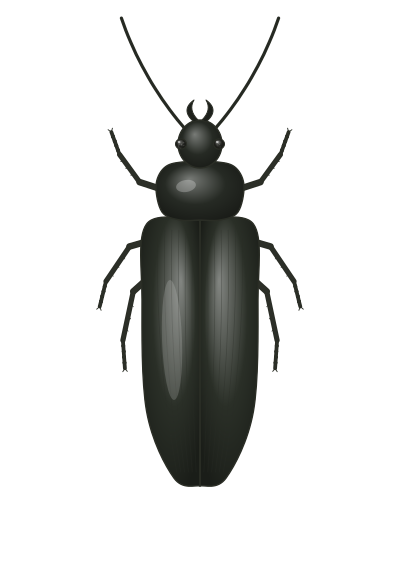
What Do Termites Look Like? Workers, Soldiers, Swarmers and Young
A caste-by-caste description of the termites people find in and around houses, with the features that separate them from ants.
Quick answer
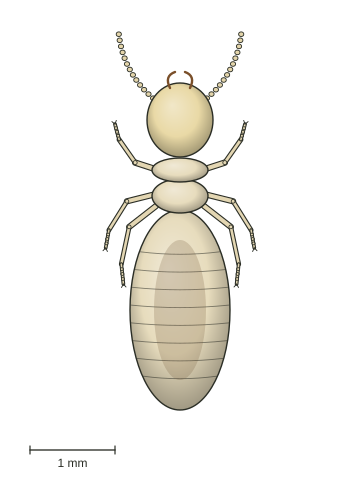
Most termites in a colony are workers: soft, wingless, creamy white to pale caramel insects about 6 mm (1/4 inch) long. Soldiers are the same size with a long yellowish or amber head and large jaws. Swarmers are dark brown or black, 10 to 13 mm (3/8 to 1/2 inch) long, with four equal wings about twice the length of the body.
A termite you find inside wood or a mud tube is almost always a worker: a soft, wingless insect about 6 mm (1/4 inch) long, creamy white to pale caramel, with a straight body and no narrow waist. The dark, winged termites that appear at windows in spring are swarmers from the same colony. They look so different from workers that many people assume they are a separate insect.
Which one you found matters. A worker means you have opened an active feeding site. A swarmer indoors usually means a mature colony is in or under the building.
The three forms you might see
A termite colony is divided into castes, and each has its own body shape.
| Caste | Size | Color | Wings | What stands out |
|---|---|---|---|---|
| Worker | About 6 mm (1/4 inch) | Creamy white to light caramel | None | Soft body, hides from light |
| Soldier | About 6 mm (1/4 inch) | Pale body, yellowish to amber head | None | Long head with large jaws |
| Swarmer | 10 to 13 mm (3/8 to 1/2 inch) with wings | Dark brown to black, or yellowish brown | Four, equal length | Wings about twice as long as the body |
Sizes here are for the eastern subterranean termite, the species Penn State Extension describes and the most widespread in the US. Other subterranean species are close to it.
Workers
Workers do the feeding, and they are the ones that damage wood. They far outnumber every other caste. Penn State describes them as creamy white. The University of California describes subterranean workers as light caramel. Either way they are pale and soft enough that people call them “white ants.”
You will rarely see a worker in the open. They stay inside wood, soil and mud tubes because they dry out quickly. People usually meet them by accident: breaking a mud tube, pulling off a piece of trim, splitting firewood or digging near a stump. Penn State notes that probing damaged wood with a screwdriver can make hidden workers spill out.
Soldiers
Soldiers guard the colony. They have the same pale body as workers, but the head is long, narrow and yellowish to amber, with a pair of large jaws at the front. Subterranean soldiers have no eyes. There are far fewer of them than workers, and workers have to feed them.
If you break open an active tube or gallery, soldiers often come to the gap. A pale insect with an oversized, darker head and visible pincers is a termite soldier.
Swarmers
Swarmers (also called alates) are the winged males and females that leave a mature colony to start new ones. In the eastern subterranean termite they are black, 10 to 13 mm (3/8 to 1/2 inch) long, with two pairs of translucent wings of equal length. The wings are about twice as long as the body and lie flat over the back at rest.

Color varies by species. Subterranean reproductives are dark brown to brownish black with brownish gray wings. Formosan swarmers are about 13 mm (1/2 inch) long with wings and fly at dusk toward lights.
The wings snap off soon after the flight, so a windowsill covered in loose, equal-sized wings is often the only thing left behind. Our guide to flying termites covers when swarms happen and what one means for your house.
Kings and queens
The founding pair are former swarmers that have shed their wings. Penn State describes them as dark brown or black and about the same length as a swarmer. The queen is the largest termite in the colony, and the University of California notes that a queen can lay thousands of eggs in a day. Both stay deep in the nest, so a homeowner almost never sees them.
What baby termites, larvae and eggs look like
People often search for termite “larvae,” expecting a grub or maggot. Termites do not have one. They develop by simple metamorphosis, the same way cockroaches do, so a young termite hatches looking like a very small, very pale worker and grows by molting.
That is useful when you find white grubs in wood. A legless or C-shaped grub with a distinct head is a beetle larva, such as a powderpost beetle. A tiny white insect with six legs and straight antennae, moving in a group with others like it, is a young termite.
Termite eggs are laid by the queen and tended by workers deep in the colony. They are not something you will find on a windowsill or a floor. Small white specks in the open are far more likely to be something else.
Termite or ant?
Winged ants swarm in the same seasons as termites, and the two get confused constantly. The EPA and the University of Kentucky both point to the same three checks.
| Feature | Termite | Ant |
|---|---|---|
| Antennae | Straight, may droop | Bent at an elbow |
| Waist | Thick, same width as the body | Narrow and pinched |
| Wings (swarmers) | Two pairs, equal length | Front pair longer than the back pair |
Workers follow the same rules. An ant worker has a clear pinch between its body sections and elbowed antennae, and it walks around in the open. A termite worker is pale, soft and straight-sided, and it avoids light.
For side-by-side drawings, see termite vs flying ant.
Other insects mistaken for termites
Two other wood insects cause most of the confusion.
- Carpenter ants. Large, dark ants that tunnel in damp wood and push out coarse sawdust. They have the pinched waist and elbowed antennae of every ant. See carpenter ants.
- Powderpost beetle larvae. White grubs inside hardwood, found only if you split the wood. Adults are small brown beetles with hard wing covers.
If you are not sure, start with the identification finder.
Where each form shows up
Where you found the insect is a strong clue to which caste it is.
- At windows, doors and light fixtures: swarmers. They are drawn to light.
- On a windowsill or floor, wings only: swarmers that have already shed them.
- Inside a broken mud tube: workers, and often a few soldiers.
- Inside damaged wood or behind trim: workers.
- In a stump, log or woodpile in the yard: workers and soldiers from a colony in the soil. Extension specialists do not treat that alone as proof the house is infested.
What to do if you find one
Collect a few specimens before you clean up. A small jar or a zip bag is enough, and a clear photo next to a coin helps. An inspector can identify the species from a swarmer or a soldier, and the species affects which treatments make sense.
Then look for the other evidence. Check the foundation, crawl space and sill plates for mud tubes, and windowsills for wings or pellets. The signs of termites guide lists each one.
You do not need to act the same day. The University of Kentucky notes that termites damage wood slowly, so taking a few days or weeks to get more than one opinion makes little difference. A termite inspection by a licensed company is the next step.
References
- Eastern Subterranean Termites. Penn State Extension.
- Subterranean and Other Termites: Pest Notes. University of California Statewide IPM Program.
- Termite Control: Answers for Homeowners (ENTFACT-604). University of Kentucky Entomology.
- Termites: How to Identify and Control Them. US Environmental Protection Agency.
- Signs of Termite Infestation. Mississippi State University Extension.
See also
- Termites: types and identification
- Flying termites and swarms
- Termite vs flying ant
- Signs of termites
- Termite inspection
This page was last updated on November 10, 2026. We research our guides from university extension services, government agencies, museums and peer-reviewed literature. Read the editorial policy or report an error.